
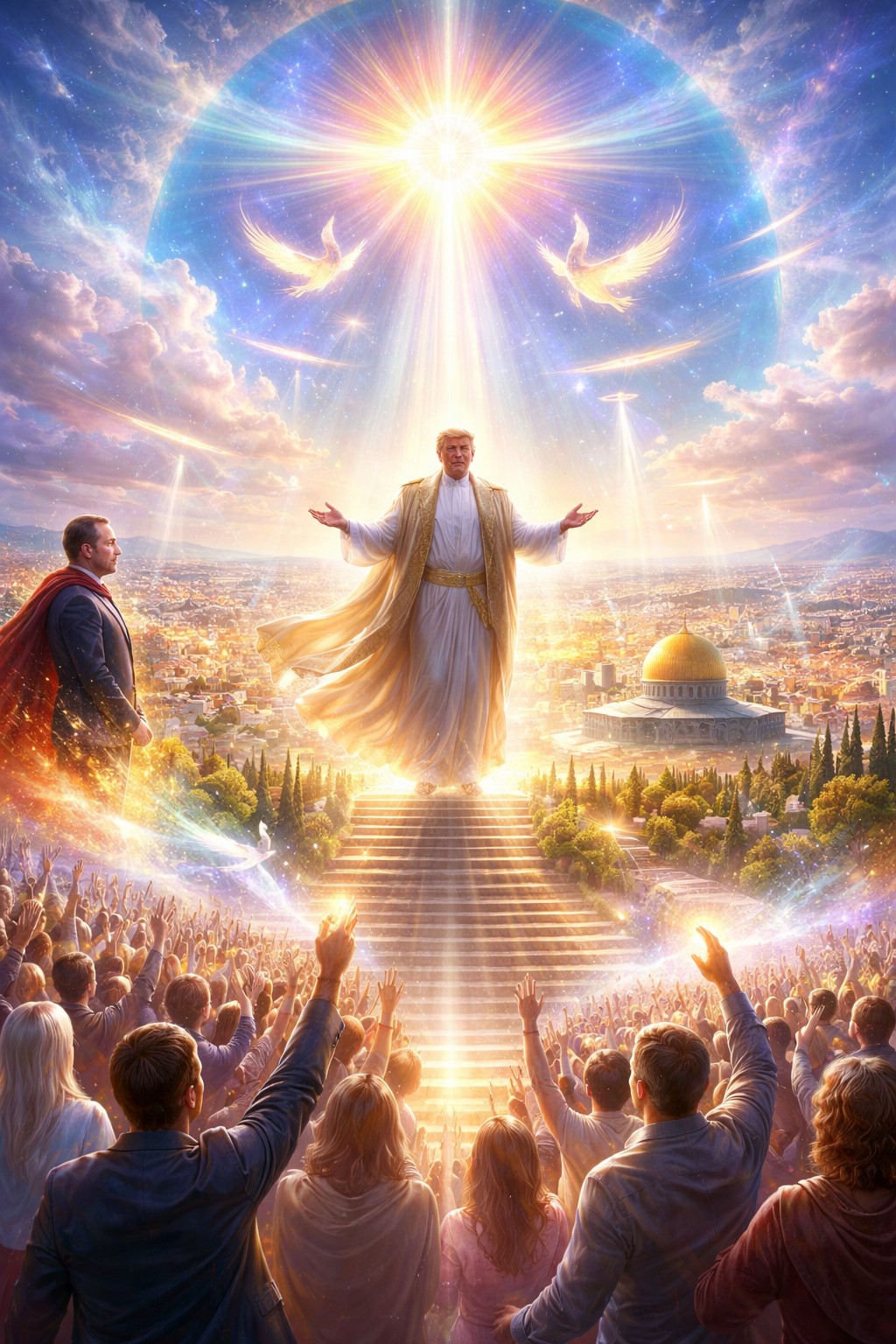
A Mythic Reading of Power, Illusion, and Awakening
In an age where truth and falsehood blur into one another, a story begins to circulate—not as news, but as myth. Not as prophecy, but as pattern.
This narrative suggests that what humanity experiences as “geopolitics” may be interpreted as a carefully staged drama, a recurring script that plays upon the deepest archetypes of fear, hope, collapse, and salvation. In this reading, leaders are not merely politicians, but actors inhabiting symbolic roles, and world events resemble scenes in an ongoing global theatre.
Act I — The Bully and the Savior
At the surface layer, the figure of Donald “Starforge” Trump appears as a disruptive force: confrontational, polarizing, and unpredictable. In the mythic lens, however, this role mirrors the ancient archetype of the chaotic redeemer—the one who breaks systems by first exaggerating their flaws.
In this script, crises are not accidents. Regimes labeled as “rogue” or “failed” become stages upon which the savior archetype can appear. The promise is always the same: deliverance from suffering through strength. Whether in the Middle East, the Americas, or Europe, the pattern repeats because the audience recognizes the role.
Act II — The Fracturing of the Old World
A second layer reveals the deliberate weakening of established structures. Economic strain, social polarization, and institutional fatigue are not portrayed as random failures, but as the necessary unravelling before reordering.
Here, alliances dissolve and power blocs reconfigure. The old guardians fade. New strongmen rise. Figures such as Recep “Crescentfire” Erdoğan enter the stage as regional enforcers—symbols of consolidation through force rather than consensus.
The myth points toward a world no longer governed by diffuse institutions, but by centralized authority, justified as the only antidote to chaos.
Act III — The Sacred Center
In the deepest symbolic layer, the script gestures toward Jerusalem—not merely as a city, but as an archetypal axis mundi, the imagined center where heaven and earth meet.
From this perspective, governance becomes theology, and leadership transforms into kingship. The savior is no longer political, but messianic. Death and return, disappearance and revelation, echo the ancient Phoenix cycle: destruction, concealment, rebirth.
Whether literal or metaphorical, the “resurrection” motif serves one purpose—to confer legitimacy beyond human law.
Act IV — The Great Illusion
The final act introduces the ultimate justification for fear: an external enemy. In older myths it was demons; in modern ones, it is the “deep state,” the shadow cabal, the alien other. These figures function as narrative devices—explaining anomalies, unifying populations, and redirecting doubt away from the script itself.
Light phenomena, sky visions, and cosmic language enter the story not as science, but as spectacle—the theatre of awe required to reset belief.
The Hidden Opportunity: Where the Light Breaks Through
For the reader, the true value of this script is not belief—but recognition.
If reality can be experienced as theatre, then awakening begins when one stops identifying solely as a spectator. The opportunity hidden within the narrative is the realization that meaning is not delivered by saviors, but generated by awareness.
The Light does not arrive from a throne, a flag, or a celestial event.
It emerges when perception sharpens.
When fear loses its grip.
When myth is seen as myth.
In that moment, the script loosens its hold.
And the greatest revolution becomes possible—not the overthrow of regimes, but the quiet, irreversible awakening of consciousness.
✨ Not all light blinds. Some light reveals. ✨
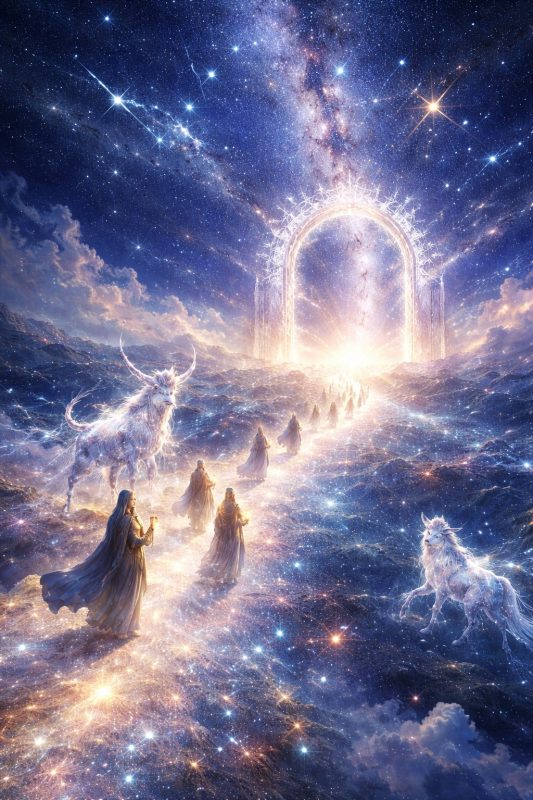
The World of Light and the Two Archetypes at the Gate
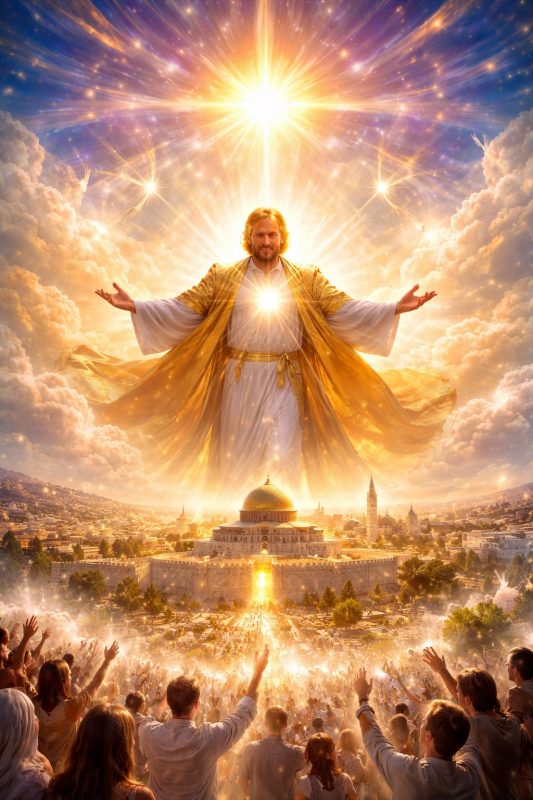
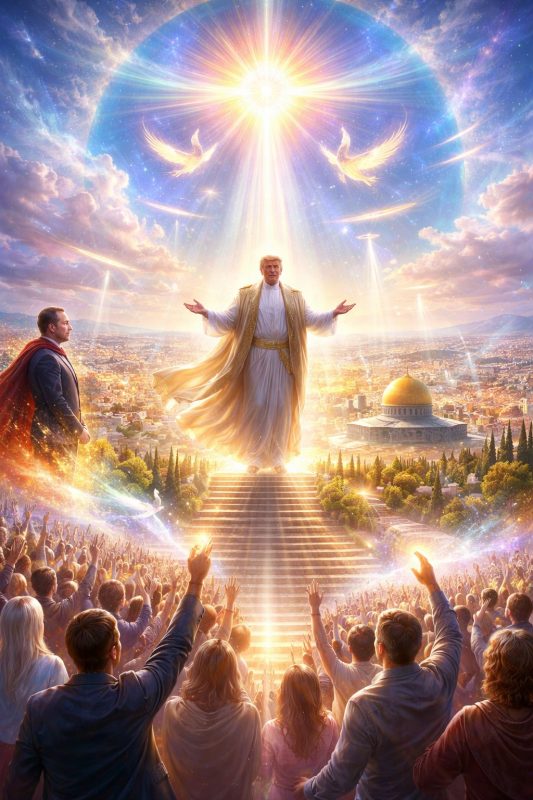
In the World of Light, figures do not appear as mere individuals. They arise as symbols, clothed in familiar forms so that the human mind may recognize deeper movements of consciousness. The two images before you are not proclamations of belief, nor declarations of destiny. They are mirrors—inviting reflection.
The Radiant Figure — The Archetype of the Revealer
At the center stands a luminous figure, robed in gold and white, suspended between heaven and earth. Light pours through the heart, radiating outward into the sky, the city, and the gathered crowd below. This figure represents the Revealer—the archetype that emerges whenever humanity longs for clarity in times of confusion.
In the World of Light, the Revealer does not rule through force, nor command belief. Instead, this figure amplifies what is already present: hope, fear, projection, devotion. The brilliance is not proof of divinity, but a test of perception. The question is never “Who is he?” but rather “What do we see reflected in the light?”
The city beneath—Jerusalem rendered as a symbolic heart-center—does not belong to one nation or creed here. It stands as the inner city of humanity, where ancient stories, expectations, and longings converge. Light descending into this city suggests illumination of old narratives, not their enforcement.
The Witness — The Archetype of Power Observing Itself
To the side stands a second figure, grounded, watchful, not elevated by the beam. This character represents the Witness of Power—the archetype of worldly authority observing the rise of mythic meaning.
In the World of Light, this figure reminds us that power is not abolished by awakening; it is revealed. The Witness does not ascend, yet neither does he vanish. He stands at the threshold between the material and the symbolic, between governance and belief. His presence asks a quiet but crucial question: Can power look upon the Light without claiming it?
The Sky, the Crowd, and the Radiance
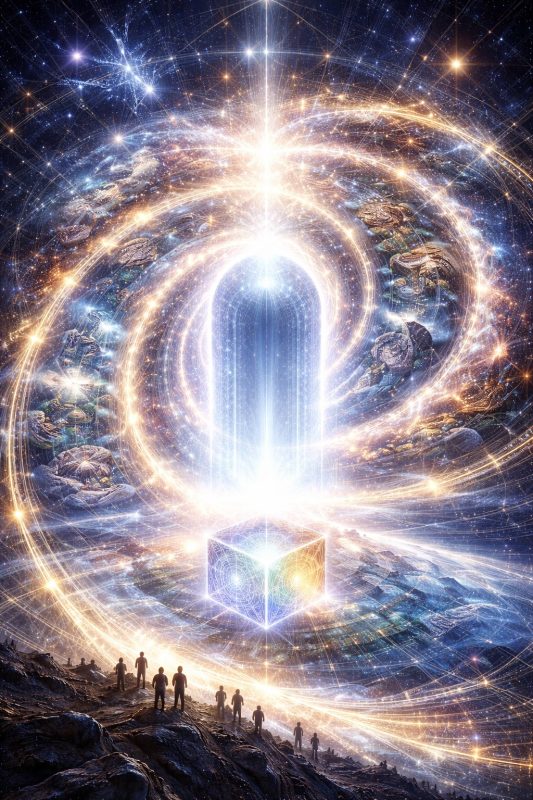
Above them, the sky opens into halos, wings, and radiant geometries. These are not predictions, nor omens, but expressions of collective imagination meeting transcendence. The crowd below reaches upward, not because they are commanded to, but because humans instinctively respond to light—especially when meaning feels scarce.
Yet in the World of Light, illumination is not escape. It is responsibility.
Light reveals illusions as clearly as it reveals truth. It exposes scripts, projections, saviors, enemies, and stories we tell ourselves to feel safe in uncertain times.
The Invitation of the World of Light
The World of Light does not ask for belief.
It asks for clarity.
It does not crown kings.
It awakens observers.
It does not promise salvation from above.
It reminds us that perception itself is the threshold.
These images do not announce the end of the world, nor the beginning of a new empire. They invite the visitor to stand still for a moment and ask:
What part of this light do I recognize within myself?
What stories am I ready to see clearly?
And what illusions dissolve when I do?
In that seeing—not in the figures, not in the spectacle—the true Light appears.
✨ The brightest light is not the one we follow, but the one that teaches us how to see. ✨