
First the Music
There is a question that quietly lives in every human being, whether noticed or not:
What remains when everything else falls away?
Not what we believe.
Not what we think.
Not even what we feel.
But what remains when the movement of the mind becomes still.
This question is not philosophical—it is experiential. And it stands at the heart of the spiritual path described by the early Sufi master Abu Talib al-Makki.
Consciousness Is Not Thought
In the beginning, we live as if we are our thoughts.
We identify with inner commentary, reactions, desires, and resistance. Life feels dense, urgent, and often fragmented. But the path begins with a subtle shift:
A growing recognition that thoughts are something we experience, not something we are.
This realization does not come through force, but through refinement.
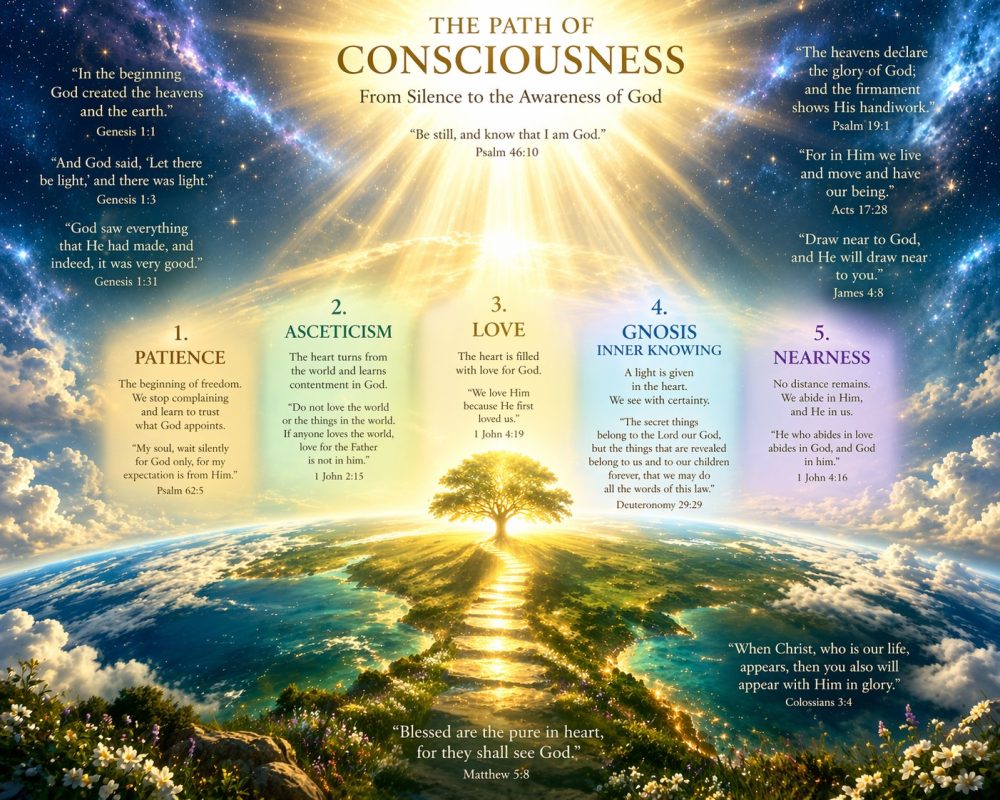
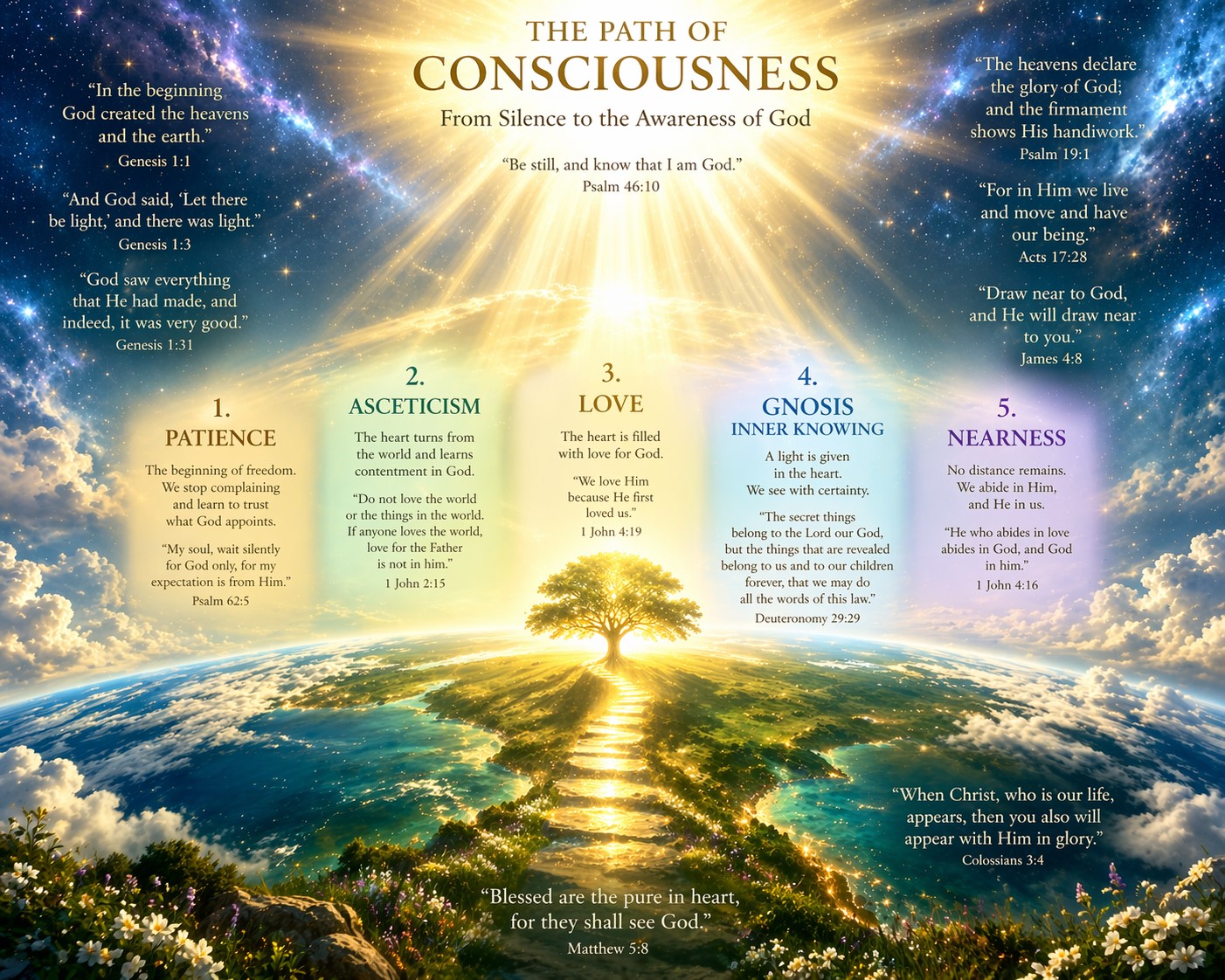
The First Movement: Patience (Sabr)
Patience is not passive endurance. It is the first disentanglement from unconscious reaction.
It unfolds in three deepening stages:
- First, one stops complaining. This breaks the cycle of resistance.
- Then, one becomes inwardly content with what unfolds.
- Finally, one comes to love what is given.
At this point, something profound begins to happen:
The mind loses its compulsive urgency.
And in that softening, awareness begins to separate from thought.
The Second Movement: Asceticism (Zuhd)
Asceticism, in its inner meaning, is not rejection of the world—it is freedom from dependence on it.
As attachment to fleeting things weakens, a new orientation emerges:
- The heart turns away from constant stimulation
- Desire loses its central authority
- Stillness becomes more natural than seeking
This is not emptiness as loss—but emptiness as clarity.
And in that clarity, thinking begins to quiet on its own.
Not suppressed.
Simply no longer needed in the same way.
The Third Movement: Love
When the heart is no longer occupied by grasping, something unexpected appears:
Love—not as emotion, but as a state of being.
This love is not directed. It does not depend on conditions.
It is the recognition that what remains in silence is not cold or empty—but alive, present, and intimate.
At this stage, awareness is no longer something abstract.
It is felt as nearness.
The Fourth Movement: Gnosis (Ma‘rifa)
Through love, a deeper form of knowing emerges—what the tradition calls gnosis.
This is not knowledge about God.
It is knowing through presence.
Like light that reveals without explanation.
In gnosis:
- Awareness becomes self-evident
- Reality is no longer filtered through conceptual thought
- The “observer” and the “observed” begin to dissolve into one field
This is why it is described as a light in the heart.
Because it illuminates without mediation.
The Final Realization: Nearness Without Distance
At the culmination of this path, something unexpected is discovered:
There was never a distance to cross.
What we call “the awareness of God” is not an experience added to the self—it is what remains when all that is not essential falls away.
When thought becomes still,
when desire no longer pulls,
when resistance dissolves—
what remains is presence.
And that presence is not separate from the Divine.
The Meeting Point
The path described—
patience → asceticism → love → gnosis → nearness—
is not a ladder toward something distant.
It is a process of uncovering what has always been here.
Consciousness, in its essence, is not the movement of thought.
It is the silent, aware presence in which all experience appears.
And when this presence is fully recognized, it is known—not as an idea, but as a living reality—
as the awareness of God.
A Closing Reflection
For those walking this path, the invitation is simple, though not always easy:
Not to add more,
but to see more clearly.
Not to become something else,
but to recognize what remains
when nothing else is held onto.
In that recognition,
the Crown of Light is not something to be reached—
but something already shining,
quietly, within.