
THE ECLIPSE EXPERIMENT
Look at the Sky. Look Beside It. Look Within.
August 12, 2026
Tomorrow, millions of people will look toward the Sun.
They will wait for the Moon to cross its face.
They will watch the light change.
They will photograph the eclipse.
They will listen to experts explain what they are seeing.
And then they will look away.
But what if the real experiment begins before the eclipse?
What if, instead of telling you what to see, we simply invite you to look?
No conclusion.
No predetermined answer.
No belief required.
Just the sky.
THE QUESTION
The conventional astronomical model says that a solar eclipse occurs when the Moon passes between the Sun and Earth.
NASA describes the August 12, 2026 event as a total solar eclipse whose path of totality crosses Greenland, Iceland, the Atlantic and Spain, while much of Europe experiences a partial eclipse.
In the Netherlands, the eclipse will be partial. It begins at approximately 19:14 CEST, reaches its maximum around 20:10–20:12 CEST, and ends around 21:02–21:07, depending on location. From the Netherlands, totality will not occur.
The standard model makes a straightforward prediction:
The Moon should be positioned between Earth and the Sun.
So here is the experiment:
Don’t only watch the eclipse.
Watch what happens before it.
PART I — BEFORE THE ECLIPSE
Choose a safe observation location with a clear view toward the western sky.
Begin observing well before maximum eclipse.
Do not stare at the Sun.
Use certified solar-viewing glasses or another approved solar filter. Ordinary sunglasses are not sufficient. Never look through binoculars, a telescope, or a camera toward the Sun unless the optical equipment has an appropriate solar filter mounted at the front.
Now do something surprisingly simple.
Take out a notebook.
Write down:
TIME
WEATHER
WHERE IS THE SUN?
WHERE DO I EXPECT THE MOON TO BE?
Then record what you actually observe.
Do not interpret yet.
PART II — THE BLIND SPOT
This is where the experiment becomes interesting.
According to the conventional model, the Moon is in the daytime sky during a solar eclipse. In fact, NASA explicitly explains that solar eclipses occur at new moon, when the Moon and Sun are aligned on the same side of Earth.
Yet a new Moon is normally extremely difficult to see.
Why?
Because the illuminated side is facing away from Earth, while the Moon is positioned close to the Sun in our sky.
So don’t turn this into a test of:
“Can I see the Moon?”
That question is too simple.
Instead ask:
“What should I be able to observe from my location if the standard model is correct, and what do I actually observe?”
Use an astronomical app if you wish.
Record its prediction.
Record the time.
Record the position.
Then look at the sky.
And write down what you see.
Or don’t see.
Both are observations.
PART III — DON’T LET THE APP ANSWER FOR YOU
This part is important.
Before opening your app, look at the sky yourself.
Describe what you see without naming it.
For example:
“Bright western sky. Thin clouds. No obvious lunar disk visible.”
Only afterward check the astronomical prediction.
Why?
Because there is a subtle difference between:
observing something
and
being told where to look for something.
The purpose of this experiment is not to prove that an app is wrong.
Nor is it to prove that the app is right.
It is to notice how easily expectation becomes part of perception.
PART IV — THE ECLIPSE
Around maximum eclipse, observe again.
In the Netherlands, approximately 88–91% of the Sun’s disk will be obscured, depending on your exact location. In Amsterdam, for example, the maximum is about 88.2%; Rotterdam is about 88.7%.
Record:
What changed in the light?
What changed in the landscape?
What changed in the temperature?
What happened to shadows?
What happened to animals or birds, if anything?
What did you expect to happen?
What actually happened?
Do not dismiss small observations.
Do not exaggerate them either.
Simply record.
PART V — LOOK BESIDE THE SUN
Now comes the Crown of Light question.
For a moment, stop looking at the eclipse itself.
Look at the whole sky.
The eclipse is an enormous event from our perspective.
But it occupies only one part of the sky.
What else is happening?
Where is the Moon according to your astronomical app?
Where are the planets?
Where is Leo?
Where is Regulus?
What can actually be seen with the naked eye?
What cannot?
And what did you assume you would see?
This is the moment when the experiment changes.
It is no longer merely an experiment about astronomy.
It becomes an experiment about attention.
PART VI — THREE STORIES
Now write three columns.
STORY ONE — THE CONVENTIONAL MODEL
What does modern astronomy say is happening?
Write it down without criticism.
STORY TWO — THE ALTERNATIVE MODEL
What alternative explanations have you encountered?
For example, some authors interpret the Sun and Moon through plasma or firmament-based models rather than the conventional astronomical model.
Write those claims down too.
But label them as claims or models, not observations.
STORY THREE — WHAT I ACTUALLY SAW
This column belongs only to you.
No NASA.
No YouTube channel.
No book.
No influencer.
No conspiracy theory.
No spiritual teacher.
No AI.
Just your observations.
THE RULE OF THE EXPERIMENT
There is one rule.
DO NOT FORCE THE ANSWER.
If your observation supports what you expected:
record it.
If your observation contradicts what you expected:
record it.
If you don’t know:
write:
I DON’T KNOW.
That may be the most valuable observation of all.
Because the moment we become desperate to make a pattern fit our preferred story, we stop observing.
We start defending.
PART VII — THE DEEPER EXPERIMENT
Now comes the part that has nothing to do with proving whether one cosmological model is correct.
Ask yourself:
How much of what I saw came from the sky?
And:
How much came from the story I brought with me?
Think about how easily attention can be directed.
A magician directs your attention toward one hand while something else happens somewhere else.
But there is an even subtler form of misdirection:
the mind can direct its own attention.
Once you believe something is significant, you begin seeing it everywhere.
Once you believe something is impossible, you may overlook evidence that challenges you.
Once you believe something is meaningless, you may never investigate it.
So the real experiment is not:
Can I prove the official model?
Nor:
Can I disprove it?
The real experiment is:
Can I remain present long enough to observe something before turning it into a story?
THE CROWN OF LIGHT PRINCIPLE
The Sun does not need us to believe in it.
The Moon does not need us to understand it.
The stars do not need our interpretation.
They simply appear.
And disappear.
And move.
And return.
The eclipse gives us something rare:
a moment when an apparently familiar world becomes strange.
Day becomes darker.
Light becomes different.
The familiar Sun becomes temporarily transformed.
And something normally hidden—the solar corona during totality—can become visible to observers inside the path of totality.
Perhaps this is why eclipses have fascinated humanity for thousands of years.
They interrupt certainty.
They remind us that the sky is larger than the story we have constructed about it.
AUGUST 12, 2026
So tomorrow:
Look up.
But look safely.
Look before the eclipse.
Look during the eclipse.
Look after the eclipse.
Look at the Sun.
Look at the surrounding sky.
Look at your instruments.
Look at your expectations.
And finally—
look at yourself looking.
Then ask:
What did I actually see?
Not:
What was I supposed to see?
Not:
What did someone tell me I would see?
Not:
What do I want this to mean?
Simply:
What did I see?
THE FINAL QUESTION
Perhaps the greatest mystery of the eclipse is not what happens to the Sun.
Perhaps it is what happens to us when something interrupts the story we thought we understood.
The Moon crosses the Sun.
The light changes.
The shadow moves across the Earth.
And millions of human beings look upward at the same moment.
Some will see astronomy.
Some will see prophecy.
Some will see coincidence.
Some will see symbolism.
Some will see evidence.
Some will see a beautiful natural event.
Perhaps all of them are seeing something real.
But the Crown of Light asks one thing before choosing among the stories:
Stay with the observation.
Because there is a difference between seeing a pattern
and deciding what the pattern means.
There is a difference between questioning a story
and replacing it with another story.
And there is a difference between being told what to see
and learning how to look.
AUGUST 12, 2026
THE SKY IS THE EXPERIMENT.
YOU ARE THE OBSERVER.
THE STORY COMES LAST.
Crown of Light
Look beyond the obvious.
Look beside the light.
And above all—
keep looking.
FIELD JOURNAL
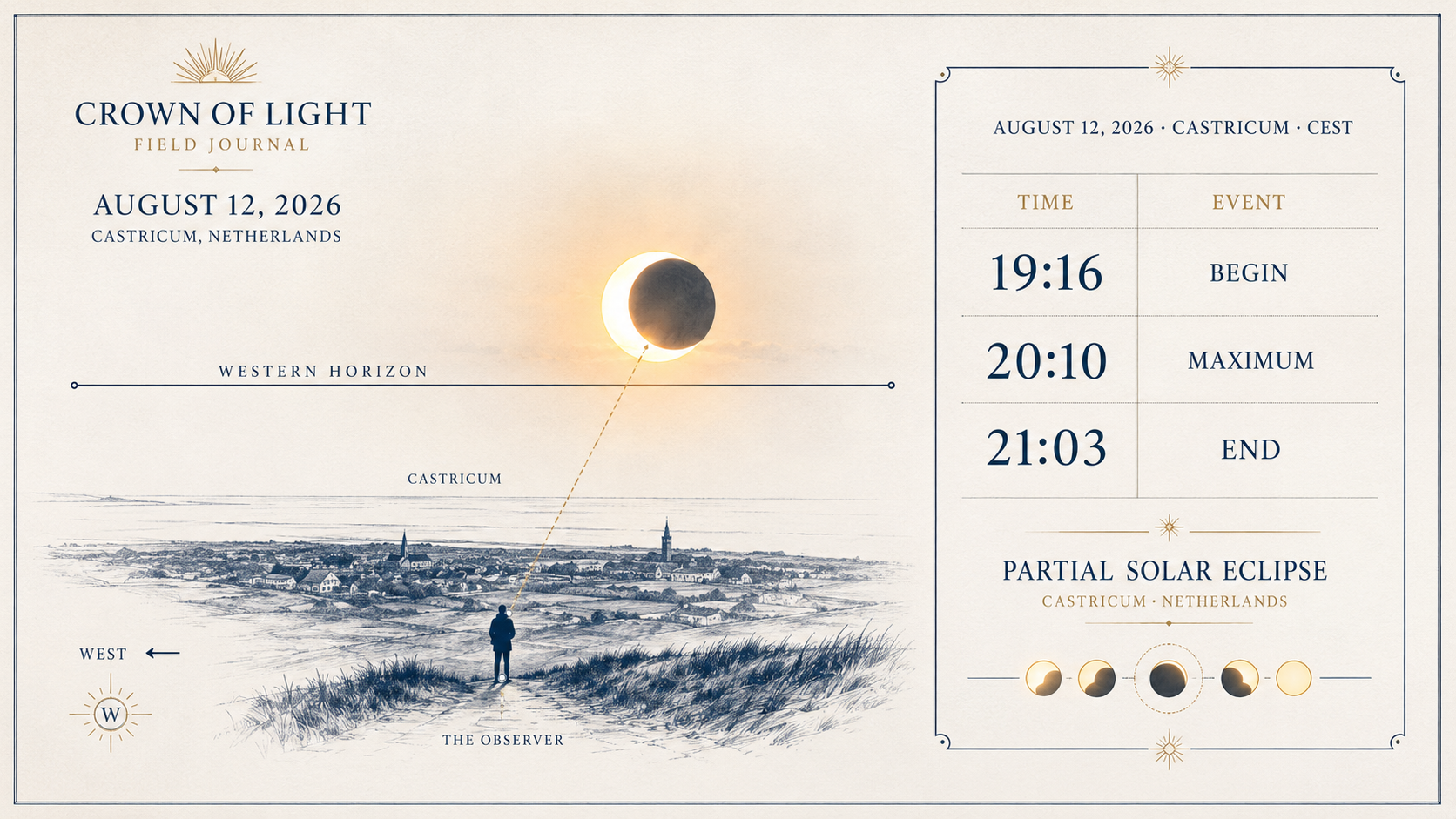
August 12, 2026 — CASTRICUM
THE ECLIPSE EXPERIMENT
Location: Castricum, Netherlands
Date: Wednesday, August 12, 2026
Time zone: CEST — UTC+2
Event: Partial Solar Eclipse
The data tells you what the model predicts.
The sky tells you what you observe.
Your journal records the difference.
YOUR LOCATION
CASTRICUM
Castricum is in the western Netherlands, close to the North Sea.
This is important because the August 12 eclipse occurs relatively low in the western sky from the Netherlands.
The Sun will be moving toward the western horizon throughout the observation period.
Your observation position
Exact location:
Castricum, Netherlands
My observation spot:
Is my western horizon open?
☐ Completely open
☐ Partly obstructed
☐ Buildings
☐ Trees
☐ Dunes
☐ Other: ______________________
01 — BEFORE YOU LOOK
What the astronomical model predicts
The standard astronomical model predicts that on August 12, 2026:
Sun → Moon → Earth
The Moon will be in its new-moon phase and will pass between the Earth and Sun.
From Castricum, the Moon will cover a large portion—but not all—of the visible solar disk.
The eclipse is therefore partial from Castricum.
Before looking:
What do you expect to see?
What have you already been told?
02 — THE ECLIPSE FROM CASTRICUM
Predicted local timeline
Partial eclipse begins:
Approximately 19:16 CEST
Maximum eclipse:
Approximately 20:10 CEST
Maximum obscuration:
Approximately 88%
Partial eclipse ends:
Approximately 21:03 CEST
These values are consistent with nearby Dutch locations; exact timings and obscuration vary slightly with observer position.
Important
There is no totality in Castricum.
You should never expect the Sun to disappear completely from this location.
Totality is visible elsewhere along the eclipse path, including parts of Iceland and Spain.
03 — FIRST CONTACT
Approximately 19:16 CEST
This is the predicted beginning of the partial eclipse from the Castricum area.
Before this moment:
What does the Sun look like?
What is the weather doing?
What can I see around the Sun?
Can I identify the Moon?
☐ Yes
☐ No
☐ Uncertain
My observation
04 — THE PREDICTED MOON
The conventional model predicts that the Moon is positioned between Earth and the Sun.
Because this is a new-moon configuration, the Moon’s illuminated side faces generally away from Earth, making the lunar disk extremely difficult to see independently in the bright daytime sky.
The eclipse itself provides the observable consequence of the predicted alignment.
Before maximum eclipse, record:
Where does my astronomical app place the Moon?
What direction does it give?
What altitude does it give?
Now put the device away.
Look.
What do I actually observe?
05 — THE WESTERN SKY
The eclipse occurs late in the day.
From Castricum, the Sun will be low in the western sky near maximum eclipse.
This makes the horizon particularly important.
My western horizon:
☐ Completely clear
☐ Partially blocked
☐ Clouds
☐ Trees
☐ Buildings
☐ Dunes
☐ Other
What can I see?
What cannot I see?
06 — MAXIMUM ECLIPSE
Approximately 20:10 CEST
At maximum eclipse, approximately 88% of the Sun’s disk is expected to be obscured from the Castricum area.
That means approximately 12% of the visible solar disk remains exposed.
Before looking:
What do you imagine 88% coverage will look like?
Now observe.
What does it actually look like?
How does the landscape look?
How does the light feel?
What happened to the shadows?
Did the temperature seem different?
Did birds or animals behave differently?
07 — LOOK BESIDE THE ECLIPSE
Now deliberately widen your attention.
Do not look only at the Sun.
Look at the entire visible sky.
What else do I notice?
Where is the Moon according to my model/app?
Where is the Sun?
What is happening around the horizon?
08 — THE TWO MODELS
Now record the two explanations separately.
MODEL A — CONVENTIONAL ASTRONOMY
The standard model says:
The Moon is a physical body orbiting Earth.
During a solar eclipse, it passes between Earth and the Sun.
Its shadow falls upon Earth.
From Castricum, the observer is outside the Moon’s umbral shadow and therefore sees a partial eclipse.
Prediction:
If this model is correct, what should I observe?
MODEL B — ALTERNATIVE PLASMA MODEL
Some alternative cosmological models propose that the Sun and Moon are not distant physical bodies in the conventional astronomical sense.
Instead, they interpret them as electromagnetic or plasma phenomena associated with an atmospheric or dome-like system.
Within such a model, an eclipse is interpreted not as a physical Moon crossing in front of a distant Sun, but as an overlap or interaction between two phenomena.
Prediction:
If this model were correct, what should I observe?
09 — THE THREE STORIES
THE CONVENTIONAL STORY
What does modern astronomy say happened?
The Moon passes between the Sun and Earth.
Its shadow reaches Earth.
Castricum lies outside the path of totality.
Approximately 88% of the solar disk is predicted to be obscured.
My observation:
THE ALTERNATIVE STORY
What alternative explanations have I encountered?
Some alternative models interpret the eclipse as an interaction or overlap of plasma/electromagnetic phenomena rather than a physical Moon obscuring a distant Sun.
This is an alternative interpretation and is not the consensus position of modern astronomy.
What would this model predict that I could independently observe?
THE THIRD STORY
WHAT I ACTUALLY OBSERVED
No theory goes here.
No interpretation.
No conclusion.
Only observation.
Before the eclipse:
During the eclipse:
At maximum:
After the eclipse:
10 — OBSERVATION VS INTERPRETATION
Separate these carefully.
WHAT I SAW
WHAT THE MODEL SAYS I SAW
WHAT I THINK I SAW
WHAT I DON’T KNOW
11 — THE HEART OF THE LION
The eclipse is an astronomical event.
But Crown of Light is also interested in the symbolic layer.
Leo is associated with the Lion.
Regulus is traditionally known as the Heart of the Lion, and its name comes from Latin regulus, meaning “little king.”
Before the eclipse:
What does this symbolism mean to me?
After observing the eclipse:
Has the symbolism changed?
12 — THE BLUE STAR
You may also have encountered stories concerning the Blue Star Kachina and the idea of a world approaching a threshold of transformation.
For this experiment, do not assume that the story predicts today’s eclipse.
Instead ask:
What does the Blue Star symbolize for me?
What does transformation mean to me?
What would returning to balance mean?
13 — THE ECLIPSE OF THE HEART
Now consider the phrase:
TOTAL ECLIPSE OF THE HEART
Before today, what did those words mean to me?
After watching the eclipse:
What do they mean now?
14 — THE OBSERVER
The most important part of the experiment may have nothing to do with astronomy.
Ask yourself:
Did I look for confirmation?
Did I resist information that challenged my expectations?
Did I notice something I had not expected?
Did I change my interpretation while observing?
Did I become more certain—or more curious?
15 — WHAT I KNOW
Complete the following sentences.
I know that…
I observed that…
I believe that…
I wonder whether…
I do not know…
16 — AFTER THE ECLIPSE
What surprised me most?
What challenged my assumptions?
What remains unexplained?
What would I need to observe next?
17 — THE FINAL OBSERVATION
Put your phone away.
Stop reading.
Look at the sky.
The eclipse has passed.
The Sun is still there.
The Earth continues turning.
The night will eventually arrive.
And somewhere beyond the blue daytime sky, the stars remain.
Now write one sentence.
Not what someone told you.
Not what you think you are supposed to believe.
Just what is true for you.
TODAY I SAW…
CROWN OF LIGHT
The purpose of the experiment was never to tell you what to believe.
It was to give you something more difficult:
the opportunity to observe before interpreting.
The models can remain.
The questions can remain.
The mystery can remain.
You do not have to resolve everything today.
Because perhaps the deepest experiment was never about the Sun or the Moon.
Perhaps it was about the observer.
What happens when you look at the world—
without immediately deciding what it means?
AUGUST 12, 2026
THE SKY IS THE EXPERIMENT.
YOU ARE THE OBSERVER.
THE STORY COMES LAST.
CROWN OF LIGHT
Look beyond the obvious.
Look beside the light.
And above all—