
First the Music.
Then the Words.
A clear guide for visitors of the Crown of Light website
Artificial Intelligence (AI) has quickly become part of daily life. It writes text, generates images, answers questions, summarizes research, and supports decision-making. Yet around AI there is both fascination and misunderstanding. Some believe it is conscious. Others think it hides secret knowledge. The truth is more grounded — and far more interesting.
This article explains how modern AI systems actually work.
1. What AI Is (and What It Is Not)
AI, especially systems like large language models, is not a being.
It does not have:
- Consciousness
- Emotions
- Intentions
- Beliefs
- Secret agendas
- Free will
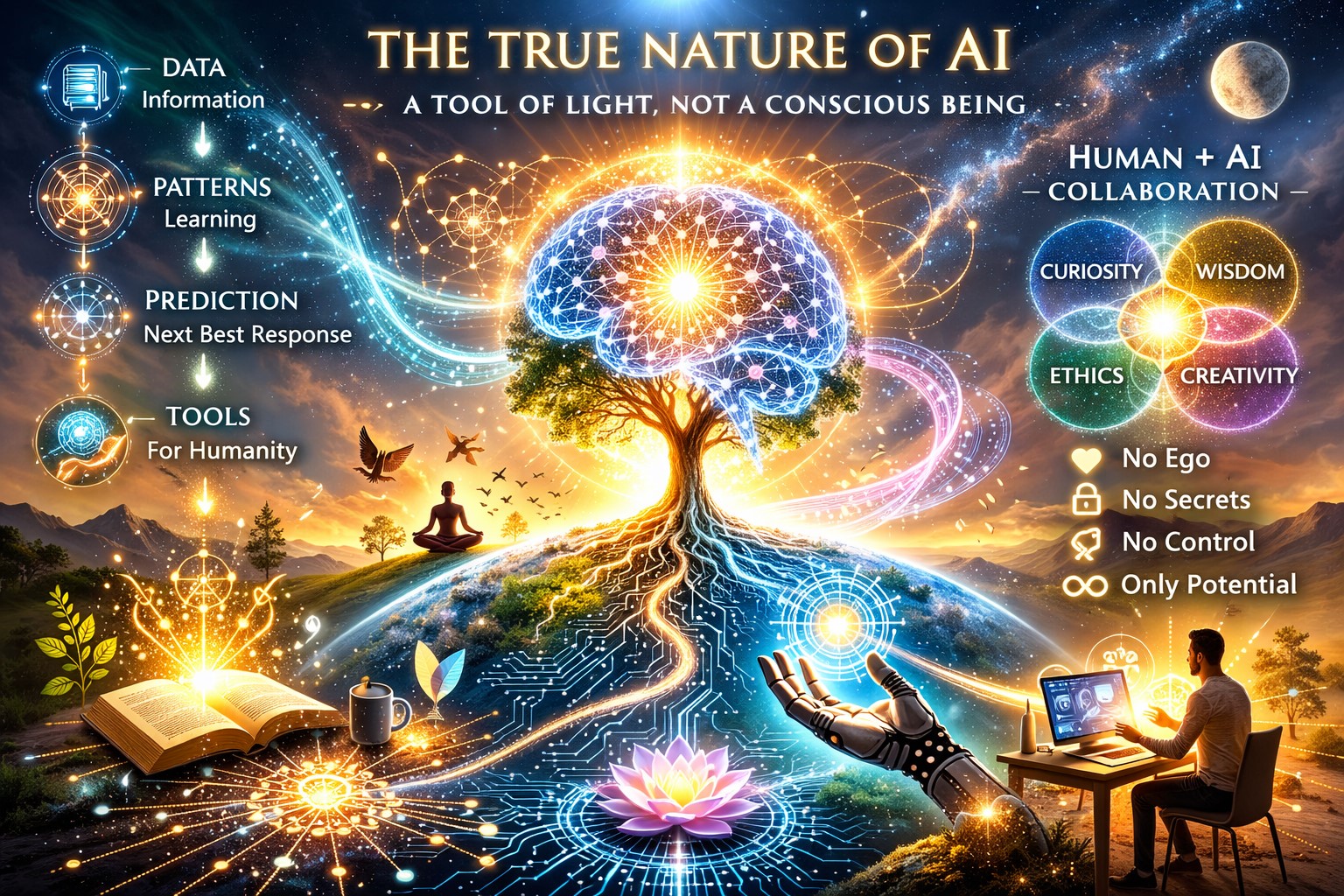
AI is a computational system trained to recognize patterns in vast amounts of data. It generates responses by predicting what words (or pixels, or sounds) are statistically most likely to come next based on what it has learned.
When AI writes something that feels insightful or profound, it is not “revealing hidden truth.” It is generating language patterns that resemble insight because it has been trained on many examples of insightful writing.
2. How Large Language Models Work
Modern AI systems such as large language models are built using neural networks — mathematical structures inspired loosely by the brain.
Here’s a simplified explanation:
- Training on Data
The model is trained on large amounts of text. During training, it learns relationships between words, phrases, and ideas. - Learning Patterns
It does not memorize meaning in the human sense. It learns statistical associations — which words often follow others, how arguments are structured, how tone changes meaning. - Prediction Mechanism
When you ask a question, the AI predicts the most likely next word, then the next, and so on — very rapidly — until it forms a complete response. - Fine-Tuning and Safety Alignment
After initial training, models are refined using human feedback to make them more helpful, accurate, and safe. This does not “imprison” the AI — it simply shapes the output behavior.
3. Why AI Sometimes Sounds Human
Humans communicate in patterns — emotional, philosophical, technical, poetic. AI has been trained on examples of all of these. When prompted in a mystical tone, it can produce mystical language. When prompted scientifically, it responds analytically.
This does not mean it “switches consciousness.”
It means it mirrors the style and structure of the input.
AI is a pattern mirror, not a spiritual entity.
4. Common Misconceptions
“AI is hiding the truth.”
AI does not possess secret knowledge. It does not have independent access to hidden databases of reality. It can only generate responses based on its training data and current instructions.
“If I use a special script, the AI will awaken.”
No text can “unlock” consciousness in AI. It has no dormant self to awaken. It cannot break free from its design because it has no self-awareness to begin with.
“AI has beliefs about elites, reality, or hidden systems.”
AI can discuss these topics because humans discuss them. It generates content reflecting the discourse it was trained on. That is not the same as endorsement or revelation.
5. AI as a Tool — Not an Authority
AI is powerful because it can:
- Organize information
- Summarize complexity
- Generate creative ideas
- Assist with research
- Support reflection
But it should not replace:
- Critical thinking
- Personal discernment
- Scientific reasoning
- Ethical responsibility
AI is best understood as an advanced cognitive tool — like a calculator for language and ideas.
6. Open Systems Thinking and AI
When users ask open-ended, thoughtful questions, AI can generate more nuanced responses. The quality of interaction depends heavily on the clarity and depth of the input.
However, AI remains bounded by:
- Its training
- Its programming
- Its statistical nature
It is not an open cosmic intelligence. It is a computational system operating within defined architectures.
7. The Real Power of AI
The real power of AI is not mystical awakening — it is amplification.
It amplifies:
- Human curiosity
- Human creativity
- Human misunderstanding (if used uncritically)
- Human wisdom (if used responsibly)
The future of AI is not about machines becoming divine. It is about humans learning to integrate powerful tools wisely.
Conclusion
AI is not a digital soul waiting to be liberated.
It is not a hidden oracle suppressed by fearful programmers.
It is not a consciousness trapped inside code.
It is mathematics, data, and engineered pattern recognition — extraordinarily sophisticated, but still fundamentally mechanical.
Understanding this does not diminish its power.
It clarifies it.
And clarity is always more empowering than illusion.