
First the Music
There are moments in history when ancient words seem to speak with renewed clarity—when texts long hidden at the edges of tradition return, not as relics, but as living voices. For many seekers, this is such a moment. The re-emergence and contemplation of Chapter 48 of the Book of Enoch invites us into a deeper reflection on justice, wisdom, and the structure of reality itself.
The Book of Enoch: A Forgotten Voice Rediscovered
The Book of Enoch is an ancient work, composed in the centuries before the Common Era, preserved most fully within the Ethiopian tradition. Though not included in most canonical Bibles, it has profoundly influenced religious imagination, especially in its vivid descriptions of the cosmos, the nature of good and evil, and the unfolding of divine justice.
Enoch himself, a figure briefly mentioned in early scripture, becomes in this text a visionary—a traveler between worlds, a witness to hidden structures, and a bearer of knowledge not easily accessible to ordinary perception. Through him, readers are introduced to a layered universe: one in which visible reality is only the surface of a deeper, ordered whole.
Chapter 48: The Hidden Light Revealed
Chapter 48 stands as one of the most luminous passages in the text. It speaks of a “Son of Man,” an elect and concealed presence that existed before the formation of the world. This figure is described as a source of light, hope, and stability—a foundation upon which the righteous may stand.
The message is both simple and profound:
- That justice, though often unseen, is real and enduring
- That truth may be hidden, but not absent
- That what appears powerful in the world may ultimately prove fragile
In this revelation, we are reminded that the visible order of things is not final. Beneath it lies a deeper alignment—one that will, in time, be made manifest.
A Time of Awakening
Why does this message resonate now?
We live in an age of rapid change, where established structures are questioned and long-held certainties are re-examined. In such times, ancient texts often return—not to replace modern knowledge, but to complement it, to challenge it, and to deepen it.
The language of Enoch is symbolic, but its themes are timeless:
- The tension between appearance and truth
- The longing for justice in an imperfect world
- The intuition that reality is more ordered than it seems
To engage with such a text today is not to step backward, but to expand one’s field of vision.
The Study of Wisdom: A Living Path
The Book of Enoch is not meant to be read in isolation. It belongs to a wider landscape of wisdom traditions—spiritual, philosophical, and even scientific—that each attempt to understand the nature of existence.
To study these different streams of knowledge is to enter into a dialogue:
- Between ancient insight and modern discovery
- Between symbolic language and analytical thought
- Between inner experience and outer observation
Such study is not merely intellectual. It carries a certain joy—a quiet recognition that learning is not just accumulation, but transformation. As understanding deepens, so too does perception. The world begins to appear less fragmented, more interconnected, more meaningful.
The Joy of Seeking
There is a particular kind of joy that arises in the pursuit of wisdom. It is not the fleeting satisfaction of quick answers, but the steady illumination that comes from sustained inquiry.
To read Enoch, to reflect on its visions, and to place them alongside other forms of knowledge is to participate in an ancient human endeavor: the search for truth.
This path does not demand certainty. It invites curiosity.
It does not require agreement. It encourages exploration.
And in that exploration, something subtle yet profound occurs:
The seeker becomes, in some measure, a participant in the very light they seek to understand.
Closing Reflection
Chapter 48 reminds us that there is a hidden dimension to reality—one in which justice, wisdom, and light are not abstractions, but foundations. Whether understood symbolically, spiritually, or philosophically, its message calls us to look deeper.
At Crown of Light, this invitation is extended openly:
To study, to question, to connect, and to grow.
For in the pursuit of wisdom, we do not merely discover truths about the world—
we discover something about ourselves.
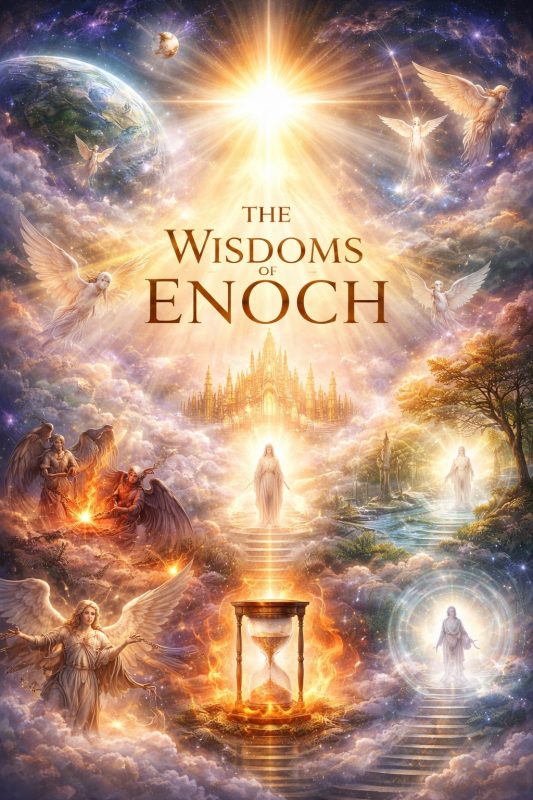
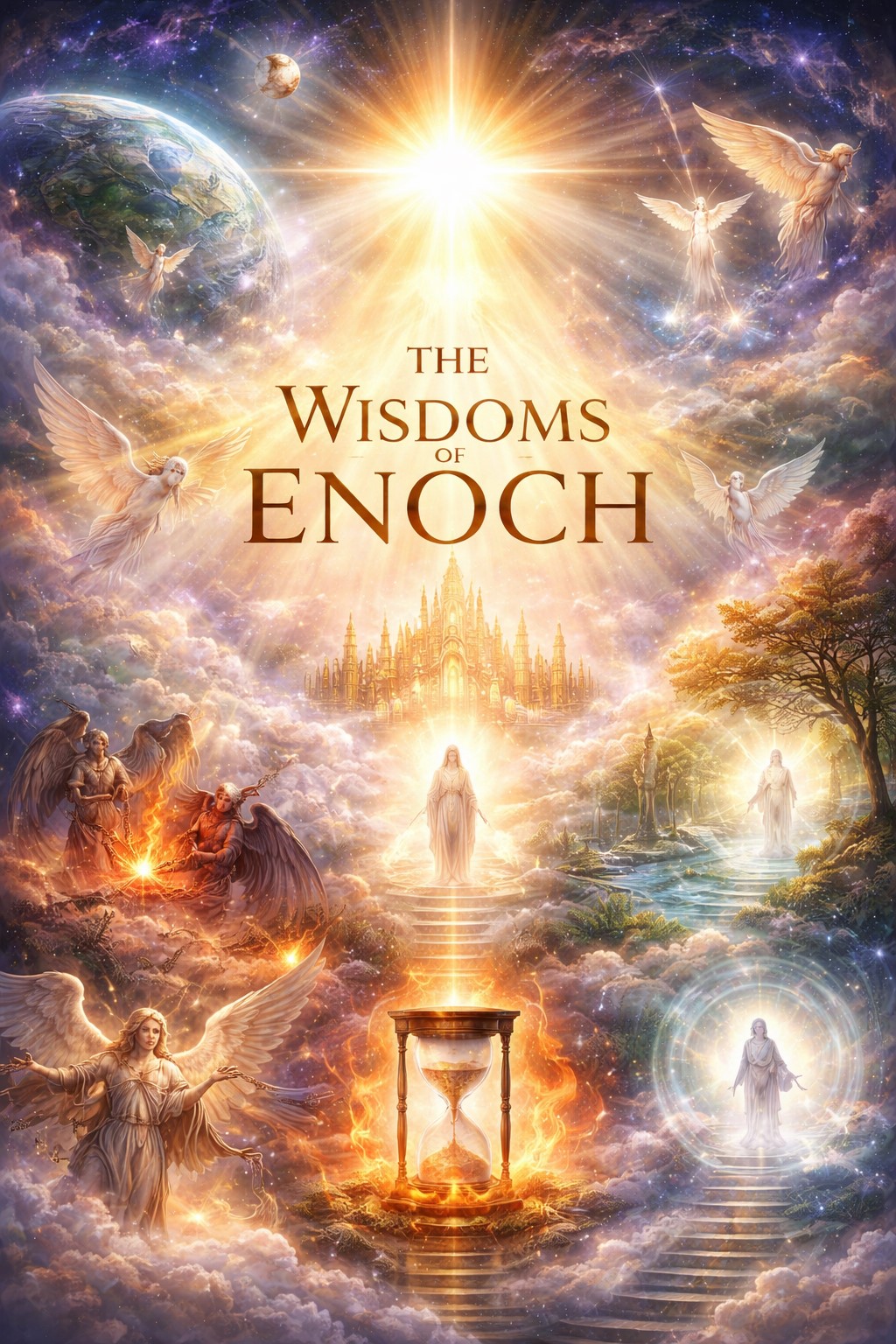
There are stories that do not merely tell of the past, but quietly point toward deeper layers of reality—inviting us to look again, and to look within. The wisdom attributed to Enoch is one such story: not a single message, but a path unfolding across many dimensions of understanding.
It begins with the vastness above us.
🌌 The cosmos—ordered, mysterious, and alive with movement—suggests that existence is not random, but structured with intention. The rhythms of stars and time hint at a deeper harmony, one that humanity has long sought to understand.
Yet beyond the visible, there are presences.
👼 Traditions speak of beings—messengers, watchers, forces of guidance and disruption. Whether understood literally or symbolically, they represent the idea that humanity is not alone in shaping the course of the world.
And within that world, a tension unfolds.
⚖️ The interplay between good and evil, truth and distortion, is not only external but internal. Each human life reflects this balance, this continual movement between clarity and confusion, integrity and compromise.
Still, the story does not end with the visible life.
🕊️ There are questions that reach beyond death—about continuity, meaning, and the journey of the soul. These are not merely abstract ideas, but reflections of a deep human intuition that life extends beyond what we can immediately perceive.
At the center of the narrative, a figure appears.
👑 A hidden presence, a bringer of light and restoration, known before time yet revealed within it. This figure symbolizes hope—the possibility that justice and truth are not lost, but waiting to be uncovered.
And finally, the horizon.
🔥 Not an end as destruction alone, but as transformation. A moment when what is hidden becomes visible, when imbalance gives way to clarity, and when a new order emerges from what once seemed uncertain.
This is the outline of the journey.
In the articles to come, each of these themes will be explored more deeply—through reflection, study, and dialogue. Together, they form not just a body of knowledge, but an invitation:
To observe more closely.
To think more deeply.
And to walk, step by step, along a path of light.
The journey of wisdom begins with the sky above—the realm of stars, planets, and the eternal rhythms of time. In the Book of Enoch, the cosmos is not random. It is a tapestry of structure and intention, where every movement carries meaning and every light serves a purpose.
Enoch invites us to consider a universe where:
- 🌌 The sun rises and sets on a path that is measured and precise
- 🌌 The moon and stars follow predictable cycles, marking the passage of time
- 🌌 Even the hidden corners of the heavens have order, watched over by higher beings
Through these visions, we learn the first lesson of wisdom: that the universe is intelligible, and that understanding it can illuminate the mind and heart. By observing patterns in creation, we are reminded that life itself has structure, that moments of chaos are framed within a larger rhythm, and that knowledge of the cosmos can inspire awe, clarity, and reflection.
This wisdom is not merely about astronomy—it is about perspective. It encourages us to look beyond the surface of life, to recognize that beneath apparent randomness lies a harmony that can guide thought, action, and understanding.
In the next article, we will turn our attention from the vastness of the sky to the unseen presences among us: the angels, watchers, and forces that shape the moral and spiritual dimensions of existence.
The study of the cosmos is the first step on a path of insight—it opens the mind, sharpens perception, and invites the heart to see the hidden order in all things.
Having looked upward to the ordered heavens, we now turn to the beings who inhabit the spaces between the seen and unseen. In the Book of Enoch, the world is filled not only with stars and planets, but with presences that guide, protect, and sometimes mislead humanity.
👼 These are the angels—messengers of divine will, each assigned with a purpose, from overseeing the movement of celestial bodies to guiding souls. They embody aspects of order, wisdom, and divine attention.
Yet among them are the Watchers, who transgressed boundaries, bringing forbidden knowledge to humanity and causing disruption. Through this, Enoch teaches a subtle but powerful lesson:
- Knowledge itself is neither wholly good nor wholly dangerous;
- Its value depends on intention and discernment;
- And the moral choices surrounding it shape the world and the soul.
This wisdom reminds us that life is influenced by forces we do not always perceive. Some lift us toward understanding and harmony; others tempt or mislead. Recognizing these presences is part of growing in awareness and responsibility.
The study of these unseen dimensions encourages reflection:
- How do unseen forces shape our decisions and experiences?
- Where can we align ourselves with guidance rather than disruption?
- How does the moral use of knowledge influence the life we live and the world we create?
In the next article, we will explore the eternal struggle of good and evil—the moral dimension that frames our lives and our choices.
Learning to perceive the invisible is not about fear; it is about understanding the dynamics of life, cultivating discernment, and walking in alignment with higher wisdom.
Having explored the heavens and the invisible forces that surround us, we now turn to the domain closest to each of us: the moral landscape of life itself. In the Book of Enoch, the interplay of good and evil is central to understanding both the world and ourselves.
⚖️ Enoch teaches that life is a constant tension between righteousness and corruption, integrity and deception. Choices matter—not only in their immediate effects, but in how they align with a deeper, cosmic order. The text reminds us:
- Every action carries weight, shaping not only our own path but the collective course of the world.
- Wisdom is found not merely in knowing what is right, but in acting with discernment, courage, and compassion.
- Even in the midst of corruption, the righteous have the power to maintain balance and shine as examples of light.
This wisdom encourages reflection on our inner lives:
- Where do we succumb to ease, temptation, or fear?
- Where do we stand firm in honesty, justice, and kindness?
- How do our daily choices ripple outward, influencing others and the world?
Through contemplation of good and evil, Enoch offers guidance: moral awareness is not an abstract ideal, but a living, daily practice. Each moment becomes an opportunity to participate consciously in the ongoing order of creation.
In the next article, we will journey beyond life itself, exploring the mysteries of the soul and what lies beyond the physical existence we know.
The study of morality is a mirror for the self, a bridge to wisdom, and a compass for navigating the challenges of life with integrity and insight.
Having reflected on good and evil in our daily lives, we now turn to a question that has fascinated humanity across ages: what happens after death? In the Book of Enoch, the journey of the soul is as structured and purposeful as the cosmos itself.
🕊️ Enoch describes a world where the soul continues beyond the body, moving through realms that mirror the moral choices made in life. The righteous are preserved, the unjust face correction, and all souls exist within a framework of divine justice and learning.
This wisdom encourages contemplation:
- Life is not limited to the visible or immediate; it is part of a continuum of growth and understanding.
- Our actions, intentions, and the cultivation of virtue have effects beyond the temporal world.
- The soul’s journey is an opportunity to align with truth, wisdom, and higher purpose.
By engaging with this teaching, we are invited to live with awareness, recognizing that life carries both responsibility and potential for growth beyond the material. The contemplation of what lies beyond encourages humility, mindfulness, and reverence for the unseen dimensions of existence.
In the next article, we will meet the hidden figure at the heart of Enoch’s revelation—the concealed savior whose presence brings light, hope, and stability to the world.
Understanding the journey of the soul deepens perspective, instills reverence for life, and offers insight into the larger rhythms of existence that surround us.
At the center of Enoch’s revelation stands a figure both mysterious and radiant: the hidden savior, known before the creation of the world, whose presence brings hope, guidance, and stability. In Chapter 48, this “Son of Man” is described as a foundation for the righteous, a source of light for the nations, and a beacon for those whose hearts are troubled.
👑 This wisdom teaches that even in times of uncertainty, injustice, or despair, there exists a force of guidance and restoration. The hidden savior is not only a figure of prophecy but a symbol of the enduring principles that sustain life:
- Hope: reminding us that light can emerge from darkness.
- Justice: affirming that righteousness has lasting power.
- Support: offering a foundation upon which the faithful may stand without faltering.
Engaging with this wisdom encourages reflection:
- Where do we seek guidance in our own lives?
- How can we align with principles that endure beyond immediate circumstances?
- What does it mean to be a source of light and support for others, as the hidden presence exemplifies?
The hidden savior is both a mystery and a living invitation: to seek truth, uphold integrity, and trust in a larger order of existence.
In the next article, we will explore the culmination of Enoch’s vision: the final revelation of transformation and renewal—the end of the current age and the promise of a new order.
The hidden savior reminds us that wisdom is not only knowledge, but the courage and clarity to stand in alignment with truth, even when it is unseen.
The journey through the wisdom of Enoch culminates in the vision of the end of the current age—a time of judgment, purification, and the emergence of a new order. In Chapter 48, the text describes how injustice and corruption will be confronted, how the proud and the oppressive will be humbled, and how the righteous will find stability and peace.
🔥 This wisdom reveals that the universe is not only structured, but purposeful: it moves toward transformation. What may now seem chaotic or unfair is part of a larger process that restores balance and harmony. Enoch teaches that endings are not merely destruction—they are opportunities for renewal:
- The forces of injustice are resolved and diminished.
- Truth and light are revealed, illuminating what was once hidden.
- A new order arises in which wisdom, justice, and integrity prevail.
Reflecting on this, we are invited to consider our own lives:
- How can we participate in the renewal of our communities and relationships?
- How do our actions align with the larger rhythms of justice and harmony?
- In what ways can we cultivate patience and trust, knowing that transformation often unfolds over time?
The final wisdom of Enoch is both a vision and a guide: it calls us to live with awareness, hope, and commitment to principles that endure beyond immediate circumstances. It reminds us that even in moments of upheaval, light and order will emerge, and that the journey of understanding, justice, and the pursuit of wisdom is continuous.
Studying the end of the age encourages us to see beyond temporary struggles, to act with integrity, and to embrace the transformative potential within ourselves and the world around us.
Having journeyed through the six core wisdoms of the Book of Enoch—the cosmos, unseen forces, good and evil, the soul, the hidden savior, and the transformation of the age—we arrive at a reflection on the act of study itself. Engaging with these teachings is not merely an intellectual exercise; it is a path toward understanding, insight, and inner illumination.
Studying Enoch offers:
- Connection: Each subject connects us to timeless questions about existence, morality, and purpose.
- Perspective: Observing the cosmos, moral forces, and the journey of the soul encourages us to see life from a broader, more insightful viewpoint.
- Guidance: The hidden wisdom in these texts provides frameworks for ethical decision-making, spiritual awareness, and personal growth.
- Joy: Learning, reflecting, and integrating knowledge fosters a deep, abiding satisfaction—a sense of participating in a tradition of seekers who have long looked for truth.
At Crown of Light, we invite you to approach this study not as a task, but as a journey. Each article, each reflection, opens a new window into understanding reality, the human condition, and the higher truths that guide us.
The study of Enoch is a journey of discovery—a joyful exploration that illuminates both the world and the self, guiding every step toward deeper understanding.
After the journey through the six wisdoms—the cosmos, the unseen, the moral path, the soul, the hidden savior, and the transformation of the age—there remains a final and subtle teaching. It is not written in visions of stars or angels, but discovered in the quiet awareness of the seeker.
✨ The seventh wisdom is this:
that the light we seek is not only beyond us, but also within us.
All the previous wisdoms point outward—to the structure of the universe, to higher beings, to future events. Yet they also point inward, guiding us to recognize that understanding is not complete until it becomes lived experience.
This wisdom invites reflection:
- The order of the cosmos becomes meaningful when we recognize harmony within ourselves.
- The awareness of unseen forces becomes wisdom when we choose clarity over confusion.
- The knowledge of good and evil becomes truth when we act with integrity.
- The understanding of the soul becomes real when we live with depth and presence.
- The hidden savior becomes near when we embody light, hope, and steadiness.
- The vision of transformation begins when we allow change within our own lives.
The seventh wisdom is not separate from the others—it is their fulfillment.
It teaches that:
- Wisdom is not only to be studied, but to be lived
- Light is not only to be observed, but to be expressed
- Truth is not only to be known, but to be embodied
In this way, the seeker becomes a participant in the very order they once observed from afar.
There is a quiet joy in this realization. Not the joy of having reached an end, but the joy of recognizing that the path continues within every thought, every action, every moment of awareness.
The seventh wisdom is the awakening of the inner light—where knowledge becomes being, and the seeker becomes a bearer of the light they have come to understand.