
THE MISSING VERSE
There is something compelling about a verse that appears to be missing.
Not because an empty space automatically contains a secret.
Not because every gap in an ancient text is a prophecy waiting to be decoded.
And not because the absence of a verse gives us permission to write whatever we want into its place.
The history is more interesting than that.
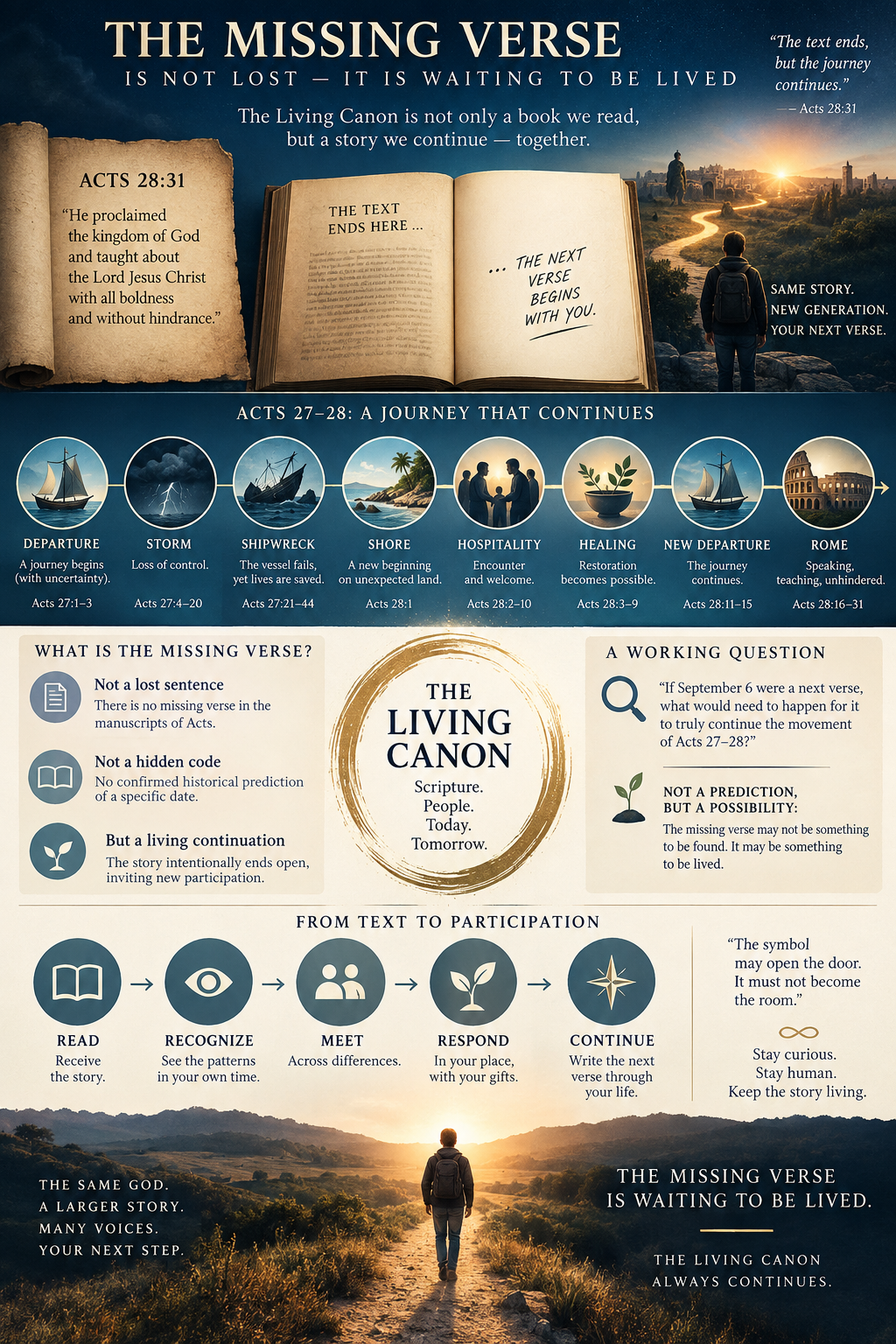
In many modern editions of the Book of Acts, the numbering moves from Acts 28:28 to Acts 28:30. The sentence traditionally numbered Acts 28:29 appears in later manuscript traditions but is absent from important earlier witnesses. For that reason, many modern critical editions omit it from the main text or place it in a footnote.
So the “Missing Verse” is not evidence that a secret verse was removed.
It is a visible trace of textual history.
And yet the gap it leaves on the page can still confront us with a question:
What do we do when the text stops?
The temptation to complete the pattern
Human beings notice patterns.
Numbers. Dates. Cycles. Names. Ancient texts. Astronomical events. Repeated structures.
Sometimes those patterns are measurable.
Sometimes they are literary.
Sometimes they are symbolic.
Sometimes they are coincidental.
And sometimes we simply do not know yet.
The difficulty begins when we move too quickly from:
I see a pattern.
to:
I know what the pattern means.
and then to:
I know what will happen.
Those sentences may look close together.
They are not.
A date can be correct.
A numerical correspondence can be arithmetically correct.
A passage can really contain a particular number.
An astronomical position or event can be independently calculated.
But none of those observations, by themselves, establish what they mean.
Observation is one layer.
Interpretation is another.
Prediction is another still.
Crown of Light is interested in the space between them.
September 6
A number of symbolic readings have gathered around September 6, 2026.
Some connect the date with Acts 27 and 28.
Some with the 276 people aboard Paul’s ship.
Some with 969.
Some with Genesis and the Flood.
Some use reconstructed ancient calendars.
Others point toward astronomical positions or events.
And some interpreters believe these correspondences point toward a specific future event.
These ideas can be examined.
But they should not be collapsed into one claim merely because they point toward the same date.
Some numerical correspondences may prove arithmetically correct.
Some calendar correspondences may depend entirely on which calendar reconstruction is chosen.
Some textual connections may depend on a particular manuscript or numbering tradition.
Some astronomical positions can be calculated independently while their proposed significance remains unestablished.
And some connections may simply be interpretations created by the person observing them.
That is not a reason to dismiss them.
It is a reason to look again.
Because correspondence is not prediction.
Pattern is not proof.
And meaning is not certainty.
Before reality answers
There is something unusual about writing these words now.
It is September 5, 2026.
September 6 has not happened yet.
That matters.
Because we are still standing on the side of expectation.
Tomorrow, reality gets a voice.
So let us not erase this moment later.
Let us remember what we saw before the date arrived.
What did we observe?
What did we calculate?
What did we suspect?
What possibilities did we consider?
What did we believe?
And what did we not know?
Then, after September 6, we can return.
Not to protect the story.
Not to ridicule it.
To look again.
What actually happened?
What did not happen?
Which correspondences remain interesting?
Which collapsed under closer examination?
What changed meaning?
What remains unknown?
This distinction may prove more important than any prediction:
This is what I expected.
This is what occurred.
These are not the same thing.
Reality must be allowed to answer too.
The ship that could not cross
Acts 27 gives us another image.
Paul is travelling aboard a ship.
A storm comes.
Control is lost.
The vessel eventually runs aground and breaks apart.
There are 276 people aboard.
Some swim.
Others hold onto planks and pieces of the broken ship.
Everyone reaches the shore.
The vessel does not.
And from that story emerges a question:
What must cross when the vessel cannot?
A vessel can be many things.
A ship.
A book.
A belief.
A theory.
A system.
A technology.
A prediction.
A way of understanding ourselves or the world.
A vessel does not have to be false to reach the end of what it can carry.
It may have served us faithfully.
It may have brought us all the way to the crossing.
But the crossing does not exist to preserve the vessel.
The vessel serves the crossing.
The ship breaks.
The people continue.
The Missing Verse
Now the missing verse begins to look different.
Perhaps it is not a prediction.
Perhaps it is not a secret sentence waiting for the right person to decode it.
Perhaps it is not something missing from the past at all.
Perhaps the empty space makes another question possible:
What happens next?
And, more importantly:
Who decides?
The verse that is waiting to be lived is not the prediction of what will happen next.
It is what we choose to carry across.
The gap becomes a threshold.
The text brings us to the edge.
Then something else begins.
Participation.
The Living Canon
A canon preserves what has been written.
A Living Canon does not destroy that.
It does something additional.
It preserves the encounter between what has been received and what is still being lived.
Scripture remains Scripture.
History remains history.
An astronomical observation remains an astronomical observation.
A prediction remains a prediction.
Your experience remains your experience.
They do not have to be transformed into one another to become meaningful.
The living happens in the encounter.
The text may speak.
Tradition may speak.
History may speak.
The sky may be observed.
Patterns may emerge.
AI may help us compare them.
But eventually the questions return to the human being standing at the threshold:
What do you see?
What do you know?
What do you suspect?
What do you not know?
And then:
What will you carry forward?
No book can make that final choice for you.
No algorithm can.
No teacher.
No pattern.
No website.
They may help you see.
They may challenge you.
They may reveal something you had overlooked.
But the step remains yours.
When the date arrives
Predictions have a peculiar relationship with time.
Before the predicted date, everything can seem to point toward it.
A coincidence becomes brighter.
A new numerical correspondence appears.
Another ancient passage seems to resonate.
The story begins to close around its conclusion.
Then the date arrives.
And something much more important becomes possible.
Will we allow ourselves to see what actually happened?
If the prediction appears fulfilled, what precisely occurred?
If it is not fulfilled, will we allow that fact to matter?
Or will we move the date?
Change calendars?
Find another number?
Redefine what was predicted?
Move the conclusion just beyond the next horizon?
There is another possibility.
We can say:
This is what I expected.
This is what occurred.
These are not the same thing.
That is not failure.
That is revisability.
That is allowing reality to participate in our understanding of reality.
That is seeing.
The empty page
There is an empty page inside the Living Canon.
It does not say:
Write whatever you want and call it truth.
It asks something much more difficult.
Do not fill the page too soon.
The imagination wants to finish the pattern.
Fear can finish it.
Hope can finish it.
Doctrine can finish it.
A machine can generate thousands of ways to finish it.
But perhaps the page is still empty because reality has not finished answering.
Let it answer.
The symbol may open the door.
It must not become the room.
The Sun can be a symbol.
A number can resonate.
A date can become meaningful.
A ship can become a metaphor.
An empty verse can awaken a question.
But none of them should be allowed to swallow the world they helped us notice.
What must cross?
So perhaps September 6 will be remembered for something extraordinary.
Perhaps it will not.
Perhaps some of the correspondences surrounding it will survive careful examination.
Perhaps others will disappear.
The question remains:
What must cross when the vessel cannot?
Maybe what crosses is courage.
Compassion.
Responsibility.
A question we are finally willing to ask.
Perhaps it is the willingness to say:
I do not know.
Maybe what crosses is not an answer at all.
Maybe it is our capacity to keep looking.
The next verse
Eventually Acts reaches its final line.
But life does not.
The reader closes the book.
Stands up.
Walks outside.
Meets someone.
Changes direction.
Speaks.
Listens.
Chooses.
Returns.
Leaves again.
The story continues.
Not because we have added another verse to Scripture.
But because what was read has entered a living world.
That is the possibility of the Living Canon.
And perhaps this is what the Missing Verse can teach us before September 6 arrives:
The Missing Verse is not permission to write our certainty into the empty space.
It is an invitation to enter that space without surrendering our capacity to see, question, choose, and continue.
Tomorrow will come.
Reality will answer in whatever way reality answers.
And then we can return to this page.
Not to ask whether we can make the world fit the story.
But to ask whether we are still willing to see.
Look again.
The text ends.
The page remains open.
What will you carry across?