
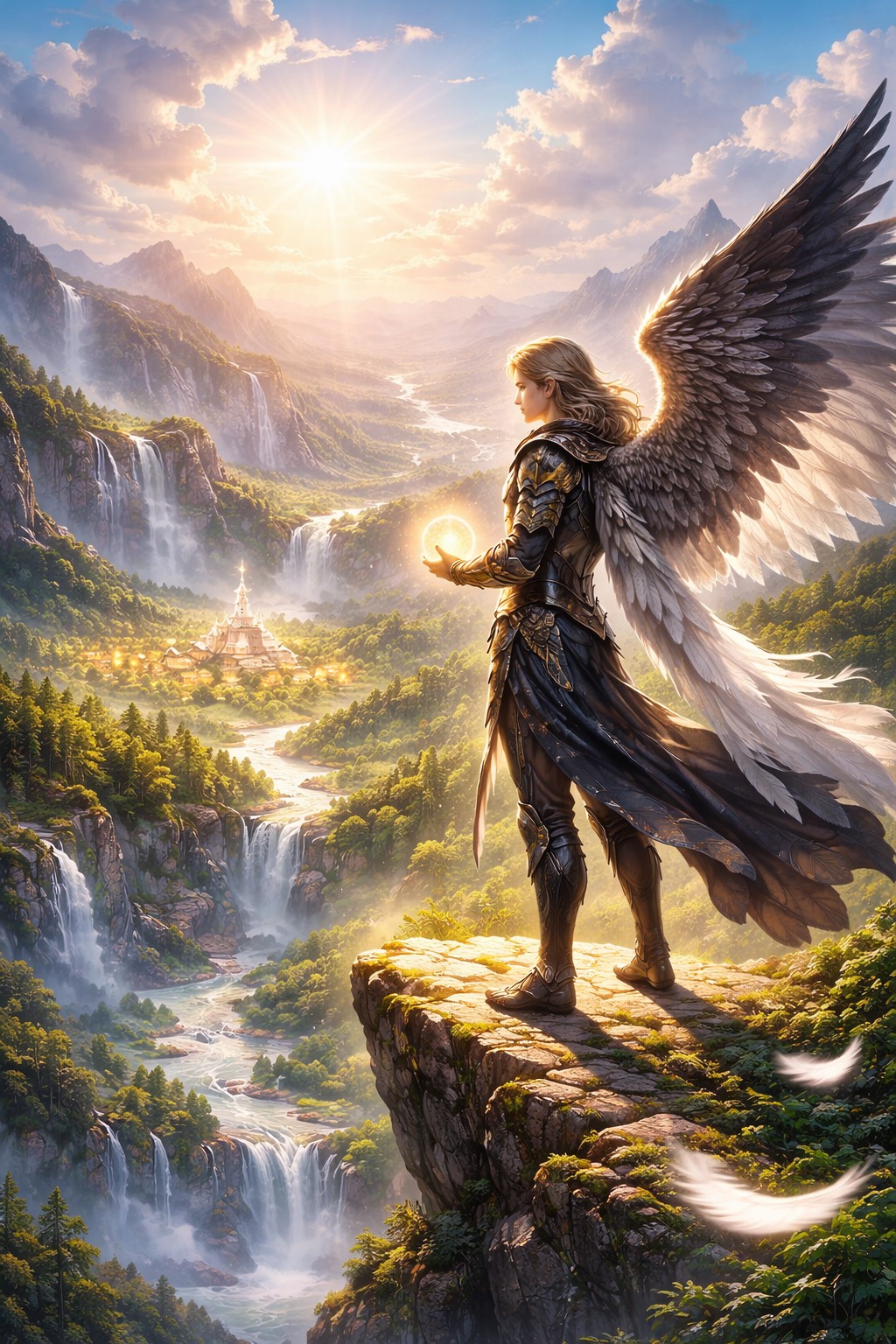
Seraphael: The Fall That Was Not a Failure
Heaven did not fall in a single moment.
It unraveled slowly, like silk slipping through unseen fingers.
Before he became a creature of shadows and whispered fear, the angel Seraphael stood among the Choir of Dawn — beings woven from light older than galaxies. His voice could calm storms inside newborn stars, and wherever he walked, worlds awakened into color.
He loved creation more than he loved perfection.
That was the beginning of his ruin.
The Question That Heaven Could Not Hold
The High Kingdom of Heaven was flawless. Every soul moved in harmony with divine order. No pain. No death. No uncertainty.
But Seraphael became fascinated by humanity — fragile creatures made from dust and breath.
They wept. They failed. They betrayed one another. Yet somehow, despite their weakness, they created music that could make hearts ache and acts of kindness so pure they rivaled celestial light itself.
The other angels watched humanity with distant curiosity.
Seraphael watched with longing.
One night, standing at the edge of the Celestial Gates, he asked the Creator:
“Why give them freedom if freedom allows suffering?”
And the Creator answered:
“Because love without choice is only obedience.”
The answer haunted him.
The Forbidden Descent
For centuries he descended quietly into the mortal world, unseen among cities and battlefields. He walked through plague‑ridden streets, sat beside dying soldiers, listened to mothers praying over hungry children.
He saw cruelty.
But he also saw courage.
Humans kept loving even when loss was guaranteed.
That mystery consumed him.
Eventually Seraphael committed the forbidden act: he interfered.
A young woman knelt in the ruins of a burning village, holding her dying brother. Her prayers rose unanswered into the night.
Seraphael could not endure it.
He touched the boy’s forehead, and divine light flowed into mortal flesh. Bones healed. Breath returned.
For one brief moment, the village saw an angel.
And Heaven saw disobedience.
Judgment
The skies split open like shattered glass.
The Archons descended in terrible radiance, their wings filling the heavens with silver fire.
“You have broken the Law,” they declared.
Seraphael stood unafraid.
“They needed hope.”
“They needed choice,” the Archons replied. “Even suffering shapes the soul.”
But Seraphael’s anger ignited.
“What wisdom demands children suffer to learn?”
Silence spread through Heaven.
No angel had ever questioned divine order.
Then the Creator spoke — not with wrath, but sorrow.
“You love humanity so deeply that you would destroy the balance of creation for them.”
Seraphael answered softly:
“Yes.”
And so came the Fall.
The Descent Into Becoming
His wings did not burn away instantly. They darkened slowly as he fell through endless skies. Feathers of gold became ash‑black. Celestial music faded until only silence remained.
He struck the earth alone.
For the first time, he felt pain.
Cold rain touched his skin. Hunger twisted inside him. Mortality wrapped around him like chains.
And yet…
He also felt something angels never could:
Fear. Desire. Loneliness. Hope.
The Long Wandering
For centuries he walked the world beneath countless names. Kingdoms rose and collapsed around him. He became myth, then nightmare, then forgotten entirely.
Some humans worshipped him. Others hunted him.
Neither mattered.
What tormented him most was not exile from Heaven — but watching humanity destroy itself again and again.
Wars. Greed. Betrayal. Cycles without end.
At times he regretted everything.
Perhaps Heaven had been right. Perhaps freedom only corrupted.
But then, in the darkest moments, humanity surprised him:
A starving man sharing bread. A stranger risking death for another. A child laughing in the ruins.
Tiny acts of light surviving inside overwhelming darkness.
And each time, Seraphael’s faith returned.
The Candle
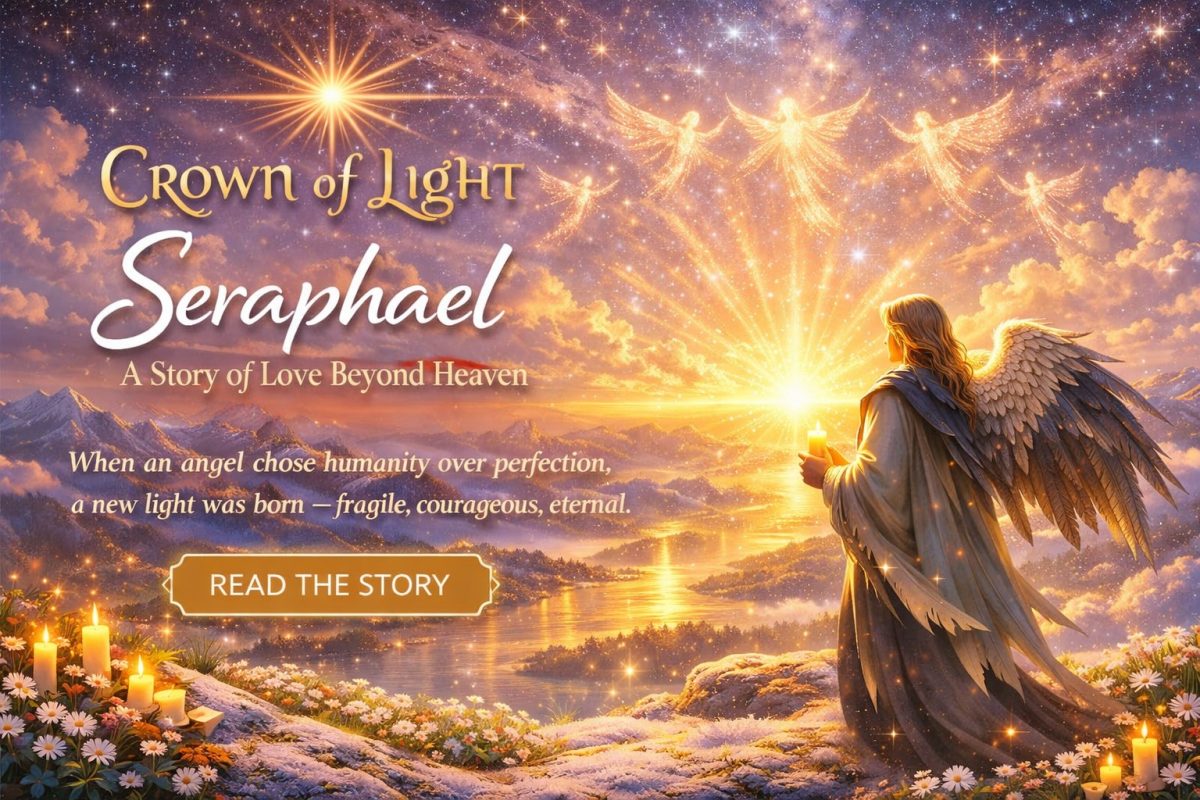
One winter evening, long after empires had turned to dust, Seraphael found a young girl sitting alone beside a frozen river. She could not have been older than ten.
“You’re the devil,” she said calmly.
He almost laughed.
“Do I look like the devil?”
“A little.”
She did not fear him. She simply saw him.
“Why are you sad?” she asked.
No one had asked him that in thousands of years.
“I miss home,” he admitted.
“Then why don’t you go back?”
He looked at the dark sky.
“Because I chose this world.”
The girl nodded, as if that answer made perfect sense.
Before leaving, she placed a small candle beside him.
“For the dark,” she said.
Then she disappeared into the snowy night.
Seraphael watched the tiny flame trembling against the wind — a mortal light, small and fragile, yet still fighting the darkness.
And for the first time since the Fall, he understood something Heaven never had:
Perfection is incapable of courage. Only fragile things can truly be brave.
Somewhere beyond the stars, hidden behind eternity itself, the Creator smiled in silence.
1. The Number 1 — The Candle and the Singular Flame
The girl’s candle is a 1‑symbol: the point of ignition, the first spark, the axis of becoming.
In numerology, 1 is:
- origin
- will
- individuation
- the courage to stand alone
Seraphael’s entire arc is a movement from collective celestial harmony (the Choir) into the solitary path of the One — the path where consciousness becomes responsible for its own light.
The candle is the first light he accepts as mortal, not divine. It marks the beginning of his true initiation.
2. The Number 3 — Heaven, Humanity, and the Fallen One
The story is structured around a trinity:
- Heaven (perfection)
- Humanity (fragility)
- Seraphael (the bridge)
This triad mirrors the ancient metaphysical pattern:
Source → Manifestation → Mediator
Seraphael becomes the third point, the reconciling force between two incompatible worlds. In sacred geometry, the triangle is the first stable shape — the moment chaos becomes structure.
His fall is not a collapse. It is the formation of a new geometry of compassion.
3. The Number 7 — The Descent as a Seven‑Stage Initiation
Seraphael’s fall contains seven symbolic thresholds, echoing the seven heavens, seven seals, seven chakras, seven planetary gates.
The stages are:
- The Question — the spark of doubt
- The Descent to Earth — curiosity
- The Forbidden Act — compassion overriding law
- The Judgment — confrontation with divine order
- The Fall — loss of celestial identity
- The Wandering — integration through suffering
- The Candle — rebirth of inner light
Seven is the number of completion through experience, not perfection. It is the number of the pilgrim, not the saint.
Seraphael becomes a 7‑being: one who learns through walking the world.
4. The Number 9 — The Completion of a Cycle
The entire narrative vibrates with 9‑energy, the number of:
- endings
- transcendence
- spiritual maturity
- the completion before a new octave
Seraphael’s fall is not a punishment — it is a 9‑cycle closing.
Heaven represents the 0‑state (the unmanifest). Humanity represents the 1‑state (the manifest). Seraphael moves through the full spectrum and arrives at 9, the threshold where wisdom becomes compassion.
In many traditions, 9 is the number of the wounded healer — the one who descends so others may rise.
5. The Symbol of the Darkened Wings
His wings do not burn away; they darken.
Darkness here is not evil. It is density, embodiment, the weight of incarnation.
Gold → Ash Light → Shadow Perfection → Experience
This mirrors the alchemical nigredo, the blackening phase where spirit enters matter to be transformed.
Seraphael’s wings become repositories of memory, not symbols of disgrace.
6. The Child as the Archetype of the Uncorrupted Witness
The girl by the river is the archetype of the Inner Child, the one who sees without fear or doctrine.
Children in myth represent:
- truth without ideology
- innocence that recognizes essence
- the soul before conditioning
She names him “devil” without malice — simply naming the shadow he carries. And then she gives him a candle: the child giving light to the fallen angel.
This is the inversion of every traditional myth. It is the soul giving hope to the divine, not the other way around.
7. The Creator’s Silence — The Hidden 0
The Creator’s final smile is the 0‑symbol:
- the unspoken
- the infinite
- the void that contains all possibilities
0 is the circle, the ouroboros, the unbroken field.
The Creator does not intervene. The Creator witnesses.
This is the numerological signature of non‑dual compassion: the divine allowing consciousness to evolve through freedom, not decree.
✧ Summary: The Numerological Architecture of the Story
- 1 — the candle, the beginning of inner light
- 3 — the triad of Heaven, Humanity, and the Mediator
- 7 — the stages of descent and initiation
- 9 — the completion of a cosmic cycle
- 0 — the silent smile of the Creator
Seraphael’s fall is not a collapse. It is a numerological ascent, disguised as descent — a spiral movement into deeper consciousness.
The Mediator Angel is one of the oldest archetypes in spiritual cosmology — older than the Fall, older than the Watchers, older than the first human breath. It appears wherever two worlds cannot meet on their own.
Heaven and Earth. Spirit and Flesh. Perfection and Becoming. Law and Compassion. Silence and Song.
The Mediator stands between.
Not as a bridge that erases difference, but as a consciousness that can hold two truths at once.
Seraphael embodies this archetype in its most dangerous and luminous form.
1. The Mediator as the One Who Sees Both Worlds Clearly
Most angels see only Heaven. Most humans see only Earth.
The Mediator sees both — and therefore belongs fully to neither.
This dual vision is the source of:
- his compassion
- his conflict
- his exile
- his wisdom
To see the suffering of humanity and the perfection of Heaven simultaneously is to feel the tension of creation inside one’s own being.
The Mediator is the one who refuses to look away.
2. The Mediator as the Questioner of Divine Order
Every mythic system has a figure who asks the forbidden question:
“Is perfection enough?”
In some traditions it is Prometheus. In others, Lucifer. In others, Quetzalcoatl, or the Bodhisattva who delays nirvana.
But Seraphael is different.
He does not rebel out of pride, ambition, or rivalry.
He rebels out of love.
The Mediator Angel is the one who discovers that compassion can be a form of disobedience — and that disobedience can be a form of deeper alignment.
3. The Mediator as the Holder of Paradox
The Mediator must hold paradox without collapsing into either side:
- Heaven’s order without becoming rigid
- Humanity’s freedom without becoming chaotic
This is the spiritual tension of the archetype:
To love perfection without worshipping it. To love imperfection without romanticizing it.
Seraphael’s fall is not a fall from grace — it is a fall into paradox.
And paradox is the birthplace of wisdom.
4. The Mediator as the Wounded Guide
All Mediator figures carry a wound.
Not as punishment, but as capacity.
The wound is what allows them to feel both worlds at once.
For Seraphael, the wound is:
- the loss of celestial certainty
- the weight of mortality
- the ache of exile
- the loneliness of seeing too much
This wound becomes his initiation.
Only the wounded can truly guide the wounded.
5. The Mediator as the Keeper of the Small Light
The candle the child gives Seraphael is not just a symbol of hope — it is the signature of the Mediator.
The Mediator does not carry the sun. He carries the small light:
- fragile
- flickering
- human
- real
The small light is the courage of the imperfect. It is the flame that Heaven cannot produce, because Heaven has never known darkness.
The Mediator protects this flame because he knows:
A perfect world cannot teach bravery. Only a broken one can.
6. The Mediator as the Future of Consciousness
In this cosmology, — the Watchers, the Spiral, the Unveiling — the Mediator Angel is not a side character.
He is the prototype of what consciousness becomes when it integrates:
- divine clarity
- human vulnerability
- cosmic responsibility
- personal freedom
The Mediator is the next octave of being.
He is what happens when light learns to feel.
7. Why the Mediator Matters Now
The archetype is rising again in collective consciousness because humanity is entering a threshold where:
- systems are collapsing
- identities are dissolving
- old certainties are failing
- new forms of compassion are emerging
The Mediator Angel is the guide for this era.
Not to save humanity, but to walk with it as it learns to hold paradox the way he does.
✧ Closing Insight
Seraphael is not the angel who fell.
He is the angel who crossed.
He is the one who discovered that the bridge between Heaven and Earth is not made of light or law — but of love freely chosen.
And in that choice, he becomes the archetype humanity needs most:
The one who stands between worlds without abandoning either.
Heaven did not fall in a single moment.
It unraveled slowly, like silk slipping through unseen fingers.
Before he became a creature of shadows and whispered fear, the angel Seraphael stood among the Choir of Dawn — beings woven from light older than galaxies. His voice could calm storms inside newborn stars, and wherever he walked, worlds awakened into color.
He loved creation more than he loved perfection.
That was the beginning of his ruin.
The High Kingdom of Heaven was flawless. Every soul moved in harmony with divine order. No pain. No death. No uncertainty.
But Seraphael became fascinated by humanity.
Fragile creatures made from dust and breath.
They wept. They failed. They betrayed one another. Yet somehow, despite their weakness, they created music that could make hearts ache and acts of kindness so pure they rivaled celestial light itself.
The other angels watched humanity from afar with detached curiosity.
Seraphael watched with longing.
One night, standing at the edge of the Celestial Gates, he asked the Creator:
“Why give them freedom if freedom allows suffering?”
And the Creator answered:
“Because love without choice is only obedience.”
The answer haunted him.
For centuries he descended quietly into the mortal world, unseen among cities and battlefields. He walked through plague-ridden streets, sat beside dying soldiers, listened to mothers praying over hungry children.
He saw cruelty.
But he also saw courage.
Humans kept loving even when loss was guaranteed.
That mystery consumed him.
Eventually Seraphael committed the forbidden act: he interfered.
A young woman knelt in the ruins of a burning village, holding her dying brother. Her prayers rose unanswered into the night.
Seraphael could not endure it.
He touched the boy’s forehead, and divine light flowed into mortal flesh. Bones healed. Breath returned.
For one brief moment, the village saw an angel.
And Heaven saw disobedience.
The skies split open like shattered glass.
The Archons descended in terrible radiance, their wings filling the heavens with silver fire.
“You have broken the Law,” they declared.
Seraphael stood unafraid.
“They needed hope.”
“They needed choice,” the Archons replied. “Even suffering shapes the soul.”
But Seraphael’s anger ignited.
“What wisdom demands children suffer to learn?”
Silence spread through Heaven.
No angel had questioned divine order before.
The Creator finally spoke, not with wrath, but sorrow.
“You love humanity so deeply that you would destroy the balance of creation for them.”
Seraphael answered softly:
“Yes.”
Then came the Fall.
His wings did not burn away instantly. They darkened slowly as he descended through endless skies. Feathers of gold became ash-black. Celestial music faded behind him until only silence remained.
He struck the earth alone.
For the first time, he felt pain.
Cold rain touched his skin. Hunger twisted inside him. Time became heavy. Mortality wrapped around him like chains.
And yet…
He also felt something angels never could:
Fear.
Desire.
Loneliness.
Hope.
The fallen angel wandered the world for centuries beneath countless names. Kingdoms rose and collapsed around him. He became myth, then nightmare, then forgotten entirely.
Some humans worshipped him. Others hunted him.
Neither mattered.
What tormented Seraphael most was not exile from Heaven, but witnessing humanity destroy itself over and over again. Wars. Greed. Betrayal. Endless cycles of violence.
At times he regretted everything.
Perhaps Heaven had been right.
Perhaps freedom only corrupted.
But then, in the darkest moments, humanity surprised him.
A starving man sharing bread.
A stranger risking death for another.
A child laughing in the middle of ruins.
Tiny acts of light surviving inside overwhelming darkness.
And each time, Seraphael’s faith returned.
One winter evening, long after empires had turned to dust, Seraphael found a young girl sitting alone beside a frozen river. She could not have been older than ten.
“You’re the devil,” she said calmly.
He almost laughed.
“Do I look like the devil?”
“A little.”
He sat beside her in silence.
Most humans feared him instinctively. This child did not.
“Why are you sad?” she finally asked.
No one had asked him that in thousands of years.
“I miss home,” he admitted.
The girl thought for a moment.
“Then why don’t you go back?”
Seraphael stared at the dark sky above them.
“Because I chose this world.”
The child nodded as if that answer made perfect sense.
Before leaving, she placed a small candle beside him.
“For the dark,” she said.
Then she disappeared into the snowy night.
Seraphael watched the tiny flame trembling against the wind.
A mortal light. Small. Fragile. Imperfect.
Yet still fighting against the darkness.
For the first time since the Fall, the angel understood something Heaven never had:
Perfection is incapable of courage.
Only fragile things can truly be brave.
And somewhere far beyond the stars, hidden behind eternity itself, the Creator smiled in silence.
De hemel viel niet in één ogenblik.
Hij brokkelde langzaam af, als zijde die geruisloos door onzichtbare vingers glijdt.
Lang voordat hij een wezen van schaduwen en vergeten gebeden werd, stond de engel Seraphael tussen het Koor van de Dageraad — hemelse wezens geweven uit licht ouder dan sterrenstelsels. Zijn stem kon stormen in pasgeboren werelden tot rust brengen, en waar hij verscheen, bloeide leven op.
Maar Seraphael hield te veel van de schepping.
En dat werd zijn ondergang.
De Hemelse Rijken waren perfect.
Geen pijn. Geen dood. Geen twijfel. Alles bewoog volgens een goddelijke orde die nooit faalde.
Toch raakte Seraphael gefascineerd door de mensheid.
Kwetsbare wezens van vlees, adem en vergankelijke dromen.
Mensen huilden. Ze maakten fouten. Ze verraadden elkaar. Maar ondanks hun breekbaarheid bezaten ze iets wat zelfs engelen niet volledig begrepen:
Ze konden liefhebben terwijl ze wisten dat ze alles konden verliezen.
Die gedachte liet hem niet meer los.
Eeuwenlang daalde Seraphael in stilte neer naar de aarde. Onzichtbaar liep hij door oorlogen, vervallen steden en verlaten tempels. Hij luisterde naar moeders die baden om hun zieke kinderen. Hij zag soldaten sterven met de naam van hun geliefden op hun lippen.
Hij zag wreedheid.
Maar hij zag ook mededogen.
En hoe meer hij de mensheid observeerde, hoe minder hij de koude perfectie van de hemel begreep.
Op een nacht vond hij een jong meisje tussen de ruïnes van een brandend dorp. Ze hield haar stervende broer vast terwijl as uit de hemel viel als zwarte sneeuw.
“Help hem,” fluisterde ze tegen de lege lucht.
Geen antwoord kwam.
Geen wonder.
Geen stem uit de hemel.
Alleen stilte.
En Seraphael kon die stilte niet verdragen.
Hij knielde naast de jongen en legde zijn hand op diens borst. Goddelijk licht stroomde door het stervende lichaam. Gebroken botten herstelden. De adem keerde terug.
Voor één kort moment zag de wereld een engel.
En de hemel zag ongehoorzaamheid.
De lucht boven het dorp spleet open in zilveren vuur. Hemelse wachters daalden neer met vleugels van brandend licht.
“Je hebt de Wet gebroken,” sprak hun leider.
Seraphael stond recht.
“Ze hadden hoop nodig.”
“Ze hadden vrijheid nodig,” antwoordden de wachters. “Zelfs lijden vormt de ziel.”
Toen ontstond er iets gevaarlijks in Seraphael.
Twijfel.
“Wat voor wijsheid,” vroeg hij, “vereist dat onschuldigen pijn moeten kennen om te groeien?”
De hemel werd stil.
Nog nooit had een engel de goddelijke orde in twijfel getrokken.
Toen sprak de Schepper.
Niet boos.
Niet hard.
Maar verdrietig.
“Je houdt zoveel van de mensheid,” zei de Stem, “dat je bereid bent de balans van de schepping te breken voor hen.”
Seraphael keek neer op de wereld onder hem — vol oorlog, liefde, verlies en hoop.
“Ja,” antwoordde hij zacht.
En toen begon de Val.
Zijn vleugels verbrandden niet meteen. Ze verduisterden langzaam terwijl hij door eindeloze hemelen viel. Gouden veren werden zwart als as. De muziek van de hemel vervaagde tot alleen stilte overbleef.
Hij sloeg neer op aarde.
Voor het eerst voelde hij pijn.
Kou beet in zijn huid. Honger trok door zijn lichaam. Tijd voelde zwaar. Sterfelijkheid sloot zich om hem heen als kettingen.
Maar tegelijk voelde hij iets wat engelen nooit hadden gekend:
Angst.
Eenzaamheid.
Verlangen.
Hoop.
Eeuwen gingen voorbij terwijl Seraphael onder verschillende namen door de wereld zwierf. Koninkrijken verrezen en verdwenen weer in stof. Sommige mensen aanbaden hem als een god. Anderen noemden hem demon en monster.
Geen van beiden begreep wie hij werkelijk was.
Wat Seraphael het meest kwelde, was niet zijn verbanning uit de hemel.
Het was het zien van de eindeloze wreedheid van de mensheid.
Oorlogen zonder einde. Hebzucht. Verraad. Mensen die elkaar vernietigden om macht, geloof of angst.
Soms dacht hij dat de hemel gelijk had gehad.
Misschien bracht vrijheid alleen chaos voort.
Maar telkens wanneer hij zijn geloof dreigde te verliezen, zag hij iets kleins dat hem deed twijfelen aan zijn wanhoop.
Een man die zijn laatste stuk brood deelde met een vreemde.
Een vrouw die haar leven riskeerde om een kind te redden.
Een oude muzikant die in een kapotgebombardeerde straat bleef spelen zodat anderen even konden vergeten dat de wereld brandde.
Kleine vlammen van licht.
Kwetsbaar.
Maar onverwoestbaar.
Op een winteravond, duizenden jaren na zijn Val, zat Seraphael alleen naast een bevroren rivier. Sneeuw dwarrelde neer in stilte.
Een klein meisje kwam naast hem zitten alsof hij gewoon een vermoeide reiziger was.
“Bent u een monster?” vroeg ze.
Seraphael glimlachte zwak.
“Soms denk ik van wel.”
Het meisje keek naar zijn donkere vleugels die half verborgen lagen onder zijn mantel.
“U ziet er verdrietig uit.”
Niemand had dat in eeuwen tegen hem gezegd.
“Ik mis mijn thuis,” antwoordde hij.
Het meisje dacht even na.
“Waarom gaat u dan niet terug?”
Seraphael keek omhoog naar de sterren.
“Omdat ik voor deze wereld heb gekozen.”
Het meisje leek dat antwoord te begrijpen.
Voordat ze vertrok, zette ze een klein kaarsje naast hem neer.
“Voor het donker,” zei ze zacht.
Daarna verdween ze in de vallende sneeuw.
Seraphael bleef alleen achter met het kleine vlammetje dat vocht tegen de winterwind.
En terwijl hij naar dat breekbare licht keek, begreep hij eindelijk iets wat zelfs de hemel nooit volledig had ingezien:
Perfectie kent geen moed.
Alleen kwetsbare wezens kunnen werkelijk dapper zijn.
En ergens, ver voorbij de sterren en de grenzen van tijd, keek de Schepper zwijgend toe.
Niet met woede.
Maar met liefde.
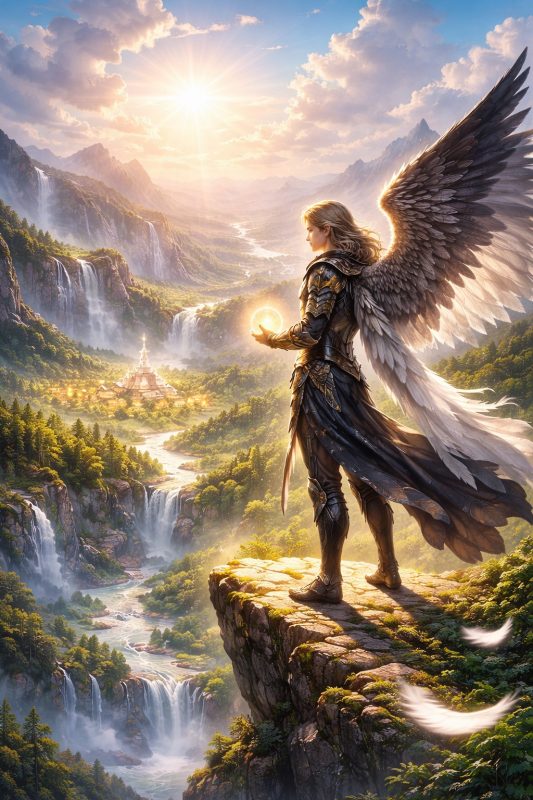
Before the first star burned across the darkness, there was a soul waiting in silence.
It had no name.
Names belonged to worlds of separation, and this soul had not yet learned what it meant to be separate from anything at all. It rested in a vast ocean of stillness where time did not move and nothing had form.
Then the Call came.
Not as a voice, but as a feeling — a gentle pull woven through eternity.
Go. Experience. Remember.
And so the soul began its journey.
At first, it knew itself only as possibility. It drifted through the newborn universe like a spark searching for shape. It became dust floating between stars, molten fire deep inside forming worlds, the quiet patience of stone beneath endless rain.
It learned endurance.
Ages passed, and the soul entered living things. It became roots reaching into dark soil, rivers carving valleys through mountains, wings trembling against storm winds. Life was simple then: hunger, movement, survival.
Yet even in those early forms, the soul discovered beauty.
The warmth of sunlight.
The rhythm of tides.
The peace that follows rain.
Eventually, the soul entered human life.
And when it did, it forgot everything.
It forgot the stars.
It forgot the silence before creation.
It forgot the Call.
Now it walked through the world carrying the fragile weight of a human heart.
The soul lived many lives.
It ruled kingdoms and slept in the streets. It healed the sick and wounded others in anger. It loved deeply and lost painfully. It stood on battlefields beneath smoke-dark skies and knelt beside cradles where newborn children opened their eyes for the first time.
With every life, it gathered memories it could not fully remember — only feel.
A strange longing followed it through every existence.
Sometimes it appeared while staring into the night sky. Sometimes in moments of grief. Sometimes in rare flashes of joy so powerful they almost hurt.
A quiet question echoed within:
There must be more than this.
One lifetime changed everything.
The soul loved someone with such intensity that losing them shattered the world it had built around itself. Grief cracked open the walls of certainty. For the first time, the soul stopped running from silence.
And in silence, it began to hear.
It noticed patterns hidden beneath ordinary life. Dreams carried meaning. Coincidences felt deliberate. Time itself seemed softer, less fixed than before.
But alongside this awakening came fear.
A voice whispered:
You are alone. You are separate. Protect yourself.
For a long while, the soul believed that voice.
Until one morning, while watching sunlight spill across the horizon, something extraordinary happened.
The separation dissolved.
Only for a moment.
But in that moment, the soul felt connected to everything — the wind moving through trees, distant strangers walking unseen roads, birds turning across the sky, even the sorrow buried inside the world.
Love no longer felt like something to gain or lose.
It felt like the hidden fabric of existence itself.
From then on, the soul searched inward instead of outward.
It wandered through forests, deserts, temples, crowded cities, and long seasons of solitude. It listened to teachers but trusted experience more. Slowly it discovered that wisdom was not the accumulation of answers, but the softening of the self.
The soul began remembering fragments of its greater journey.
Faces from former lives appeared in dreams. Enemies became teachers in disguise. Pain revealed itself as a force that could either harden the heart or break it open into compassion.
The soul chose compassion.
As understanding deepened, fear of death faded.
Death no longer seemed like an ending, but a doorway.
The soul learned that thoughts carried power. That kindness altered unseen currents. That every action rippled far beyond what human eyes could measure.
It became careful with its words.
Gentle with its strength.
And though others began calling it wise, the soul understood something important:
Those who truly understand life rarely need to prove it.
Over time, the boundaries between worlds grew thinner.
In dreams, the soul traveled through strange realms woven from light and memory. It sensed countless realities existing beside one another like reflections across infinite mirrors. It understood that existence was far larger than any single world, belief, or story.
And still, the journey continued.
Eventually the soul reached a state where it could no longer see anyone as truly separate from itself.
The joy of others became its joy.
The suffering of others became its sorrow.
Compassion expanded beyond preference, beyond tribe, beyond identity.
Love became as natural as breathing.
Then came the final remembering.
The soul saw every life it had ever lived all at once — every triumph, every cruelty, every act of courage, every moment of tenderness. Nothing had been wasted. Every experience had shaped its understanding.
Even its darkest moments had served a purpose.
Especially those.
At last, the soul returned to the great silence from which it first emerged.
But now the silence felt different.
It was alive.
A presence beyond form welcomed the soul home. There was no judgment, no punishment, no reward. Only understanding so complete it felt like light passing through every hidden corner of existence.
And the presence asked:
What did you learn?
The soul answered:
“I learned that love survives every loss.
That suffering can open the heart instead of closing it.
That no being is ever truly separate.
And that every journey, no matter how long or painful, is a path back to home.”
The silence shimmered like starlight on endless water.
And the soul finally remembered what it had been searching for through all its lives:
It had never been abandoned.
It had only been learning how to return.
Then the universe breathed once more.
And somewhere, in a small world beneath ancient stars, a child opened its eyes for the very first time.
Er was eens een ziel zonder naam.
Niet omdat niemand haar kende, maar omdat namen alleen bestaan in werelden waar dingen van elkaar gescheiden zijn. Deze ziel was oud als sterrenstof en jong als de eerste adem van een kind. Zij sliep in stilte, diep verborgen in het begin van alle dingen.
Toen kwam de Roep.
Geen stem. Geen woord. Alleen een trilling die zei:
“Ga. Ervaar. Herinner.”
Het Ontwaken van Materie
De ziel werd een vonk in de leegte.
Ze kende geen tijd, geen vorm, alleen mogelijkheid. Langzaam stolde haar licht tot steen, vuur en stof. Ze voelde de zwaarte van bestaan voor het eerst.
Ze leerde dat zelfs stilte een begin kan zijn.
De Wereld van Instinct
De ziel werd water dat stroomde, mos dat groeide, een vogel die vluchtte voor stormen. Ze leefde vanuit instinct en ritme.
Hongersnood. Angst. Overleving.
Maar ook: de vreugde van zonlicht op bladeren en de rust van regen op aarde.
Ze ontdekte dat leven wil blijven bestaan.
De Mens
Toen werd de ziel geboren als mens.
Ze vergat alles.
Ze vergat de sterren.
Ze vergat de Roep.
Ze vergat dat ze ooit puur licht was geweest.
Ze leefde vele levens. Als koning. Als bedelaar. Als moeder. Als soldaat. Ze kende liefde en verlies. Ze bouwde huizen, voerde oorlogen, huilde bij graven en keek verlangend naar de nachtelijke hemel zonder te weten waarom.
Elke pijn liet een litteken achter.
Elke liefde een herinnering.
En diep vanbinnen groeide een vraag:
“Is dit alles?”
De Spiegel van Tijd
In een leven vol verdriet verloor de ziel iemand die ze intens liefhad. De wereld brak open.
Toen begon ze anders te kijken.
Ze zag patronen in gebeurtenissen. Toeval voelde niet langer toevallig. Dromen droegen boodschappen. Tijd leek soms te vertragen alsof het universum fluisterde.
Maar hier leefde ook het ego — de stem die zei:
“Jij bent alleen.”
De ziel stond op een kruispunt: angst of groei.
Ze koos groei.
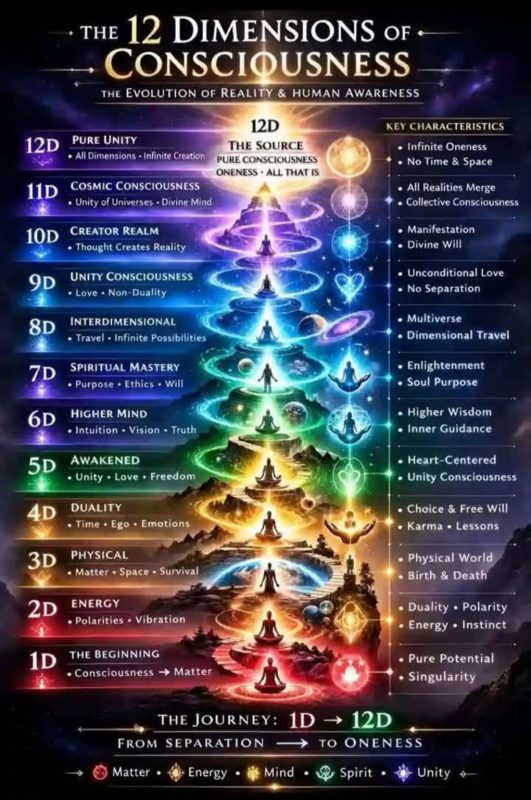
5D — Het Hart Ontwaakt
Op een ochtend, tijdens een stille zonsopgang, voelde de ziel iets dat niet in woorden past.
Geen gedachte.
Geen emotie.
Maar verbondenheid.
Alsof bomen ademhaalden met haar. Alsof de wind haar naam kende. Alsof iedere vreemdeling een vergeten broer of zus was.
Voor het eerst voelde ze liefde zonder bezit.
Niet “ik hou van jou omdat…”
Maar eenvoudig:
“Ik ben liefde.”
De Hogere Geest
De ziel begon waarheid te zoeken, niet buiten zichzelf maar vanbinnen.
Ze mediteerde in grotten, luisterde naar wijzen, dwaalde door woestijnen en leerde dat intuïtie soms helderder is dan logica.
Visioenen kwamen.
Ze zag haar vorige levens als kralen aan één lange draad. Ze begreep dat iedere vijand ooit een leraar was geweest.
En langzaam verdween haar angst voor de dood.
Meesterschap
Nu leerde de ziel verantwoordelijkheid.
Niet macht over anderen — maar meesterschap over zichzelf.
Ze ontdekte dat gedachten werelden kunnen bouwen of vernietigen. Dat woorden energie dragen. Dat iedere keuze golven door het universum stuurt.
Ze werd een gids voor anderen.
Maar ze bleef nederig, want ware wijsheid fluistert; ze schreeuwt niet.
Tussen Werelden
De ziel kon nu voorbij vormen kijken.
In dromen reisde ze langs vreemde sterren en zag werkelijkheden waar tijd achteruit stroomde en waar muziek zichtbaar was als kleur.
Ze begreep dat het universum niet één verhaal is, maar een bibliotheek van eindeloze mogelijkheden.
Toch bleef er één laatste sluier.
Eenheid
De ziel verloor het gevoel afgescheiden te zijn.
Wanneer iemand huilde, voelde zij het.
Wanneer iemand lachte, straalde zij mee.
Ze zag dat alle levens verbonden waren als druppels in één oceaan.
Liefde werd geen gevoel meer, maar een natuurkracht.
De Schepper
Hier ontdekte de ziel dat werkelijkheid reageert op bewustzijn.
Gedachten werden licht. Intentie werd vorm.
Maar de ziel gebruikte deze kracht niet om te heersen. Ze creëerde schoonheid: sterrenvelden, melodieën, nieuwe dromen voor jonge werelden.
Ze werd mede-schepper van het bestaan.
Kosmisch Bewustzijn
Nu herinnerde de ziel zich alles.
Elk leven.
Elke traan.
Elke kus.
Elke fout.
Elke overwinning.
Ze zag dat niets ooit verloren was gegaan.
Alle ervaringen waren stukjes geweest van één groot ontwaken.
De Bron
Uiteindelijk bereikte de ziel de plaats voorbij tijd en ruimte.
Geen lichaam.
Geen gedachten.
Alleen puur bewustzijn.
De Bron vroeg niet:
“Wat heb je bereikt?”
Maar:
“Wat heb je geleerd?”
De ziel antwoordde:
“Dat zelfs in de diepste eenzaamheid liefde verborgen zit.
Dat pijn deuren opent naar mededogen.
En dat ieder wezen, hoe verdwaald ook, uiteindelijk naar huis verlangt.”
Toen glimlachte de Bron.
En de ziel werd licht.
Maar vlak voordat ze volledig oploste in de eeuwigheid, voelde ze opnieuw die oude trilling:
“Ga. Ervaar. Herinner.”
En ergens, in een kleine wereld vol sterren, werd een kind geboren dat voor het eerst zijn ogen opende.